

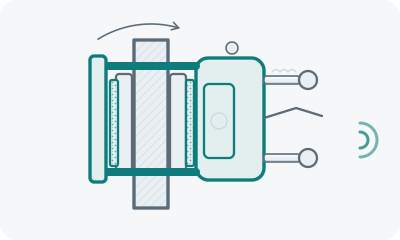
The steering wheel starts to shiver, or to swing noticeably from side to side, the moment you press the brake — and the faster you were going, the stronger it gets. It is a recognisable symptom, and it almost always points one way: at the brake discs and at everything that stops them working evenly. The good news is that the cause is usually found in a single visit to a lift. Below is where the judder comes from, how to tell it apart from other vibrations, and when machining the discs is enough.
Telling it apart from other vibrations
The first thing to pin down: does the judder appear only when you press the pedal, or is it there all the time? If the car shakes without braking as well, at a steady speed around 100 km/h, that is a different story — most often wheel imbalance.
Second, where the pulsation is felt:
- in the steering wheel — the front discs are at work: they are tied to the steering through the hub carriers, and any unevenness reaches the driver’s palms;
- in the brake pedal — the pulsation arrives through the hydraulics and can come from either the front or the rear discs;
- in the pedal on a slippery road or gravel — this is most likely the ABS (anti-lock braking system) doing its job: a rapid flutter of the pedal during emergency braking is normal, not a fault.
Third, the sound. Judder together with an even grinding noise is a reason to check the pads: the friction material may be worn down to the backing plate. That sound is covered on the symptom page grinding when braking.
The main culprit: the brake disc
In eight cases out of ten the wheel judders because the working surface of the disc varies in thickness. Drivers say the discs are “warped”, but visible distortion is rare — far more often the disc is worn into waves, with differences of hundredths of a millimetre, which is already enough for a pulsation you can feel.
Where uneven thickness comes from:
- Overheating. Long descents on the brakes, hard driving, towing. An overheated disc changes the structure of the metal in patches, and from then on the pads grind it unevenly.
- Sudden cooling. Red-hot brakes plus a deep puddle or a car wash straight after a drive — the classic route to distortion.
- Rust and dirt baked onto the hub. If a disc was fitted to a hub face that had not been cleaned, it sits with a microscopic tilt — and wears in waves.
- Wheel bolts over-tightened with an impact gun. Uneven torque distorts both the hub and the disc.
- Standing for a long time with the pads pressed against the disc. After a winter in a car park the disc picks up corrosion patches where the pad touched it; that judder is often temporary and rubs off over a few dozen stops.
One thing amplifies every process above — a sticking caliper. If the slide pins or the piston bind, the pad stays pressed against the disc, it overheats even in gentle driving, and the judder returns soon after the discs are replaced. The signs are a car pulling to one side, one wheel running hot and a burnt smell.
Less common causes
| What you notice | Likely cause |
|---|---|
| Judder in the wheel only under braking | Uneven thickness of the front discs |
| Pulsation in the pedal, steering calm | Rear discs or drums |
| Judder plus the car pulling to one side | A sticking caliper |
| Judder under braking and knocking over bumps | Play in a wheel bearing or track rod ends |
| Appeared right after the wheels were changed | Dirt on the hub face, over-tightened bolts |
| Pedal flutter on snow or gravel | The ABS working normally — not a fault |
Play in a wheel bearing or in the steering track rod ends does not create judder by itself, but it multiplies it: a loose joint lets the wheel move under braking force. That is why a diagnosis always checks for play alongside the discs — it is the same five minutes on a lift. Worn pads contribute too: hardened or crumbling friction material presses against the disc unevenly. The squealing side of that story is on the symptom page brake squeal.
Machining or replacement: how the decision is made
A disc with uneven thickness is either machined — a thin layer of metal is taken off on a lathe to true the surface — or replaced. There is a single criterion: the minimum thickness stamped on the disc by the manufacturer. If enough material is left after machining, the disc can be cut; if not, it is replacement only, and always in pairs on an axle. New pads go on with new discs: the old ones have already bedded into the waves of the worn surface.
Two details a workshop does not always mention. The first is the calipers: it is a false saving to skip cleaning and lubricating the slide pins while the discs are being changed, because a binding caliper is the most common way to destroy a new pair of discs within months. The second is bedding in. New discs and pads need it: for the first two or three hundred kilometres avoid emergency stops and long descents held on the pedal. The friction material then beds in evenly, and the discs last markedly longer before any judder comes back.
If you are not sure what you are feeling — judder from the discs, vibration from the wheels or the ABS doing its job — record the sound and describe the situation in the Pro-Stuk app. It matches the recording against your answers — when the shaking appears, where you feel it, whether you were braking — and shows the likely causes with an urgency level. You arrive at the workshop with a clear picture instead of a vague “something is shaking”.
