

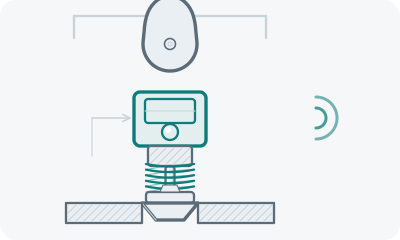
A hydraulic lifter is a small plunger that uses pressurised oil to take up the clearance in the valve train, so that nobody has to adjust it by hand. When it stops holding pressure, the clearance comes back and the follower starts hammering the camshaft lobe. From outside you hear it as rapid metallic ticking from the top of the engine. The question people ask most often is how quickly driving like that destroys the engine.
What happens inside on every revolution
In a healthy valve train the parts touch without impact: the plunger compensates for thermal expansion and keeps contact constant. As soon as a gap of a few tenths of a millimetre appears inside the lifter, the lobe no longer pushes the follower smoothly — it strikes it. At 2,000 rpm that is around a thousand impacts a minute on a single valve.
An important detail: the impact happens not only when the valve opens but also when it seats. A lifter that has lost pressure cannot take up the clearance in time, and the valve closes harder than it was designed to. On exhaust valves, which work in the hottest part of the head, that also makes it harder for heat to escape through the seat.
Metal takes those blows for a long time, but not forever. First the thin hardened layer on the lobe breaks down, then the wear goes deeper and the lobe profile changes shape. The face of the lifter and the valve suffer alongside it. That is exactly why the cost of the repair depends directly on how many kilometres you covered with the noise.
Three scenarios and where they lead
| The pattern of the noise | Likely cause | What driving on does |
|---|---|---|
| Cold only, gone in 10–30 seconds | Thick oil, slow filling | Minimal wear, keep an eye on it |
| Cold only, gone in 2–5 minutes | Dirty galleries, sticking plunger | Slow wear of the lobes |
| Constant, on a warm engine | Worn parts or low oil pressure | A ruined lobe within weeks |
| Noise plus a loss of power | Changed lobe profile, tight valve | Cylinder head work |
| Noise plus the oil pressure light | Oil starvation | Do not drive, switch off |
The last line is the only one where the clock runs in minutes rather than weeks. If the noise comes with an oil pressure warning, it is no longer the lifters that are suffering but the crankshaft bearings.
What to check before paying for a repair
Before budgeting for new lifters it makes sense to rule out the cheap causes. The first is the oil: too thick for the season, or past its service life, and it will not build pressure in narrow galleries. An oil and filter change is the least expensive diagnostic step there is.
The second is blocked oil galleries and a clogged pickup screen; here an engine flush sometimes helps. The third is oil pressure itself: it is measured with a mechanical gauge, and if it is below spec, replacing lifters is pointless until the reason for the low pressure has been found. That order is what separates a diagnosis from a guess — a workshop that quotes for lifters without measuring pressure is selling you a part, not an answer.
There is one more thing worth knowing before the work starts. On many engines the lifters sit under the camshafts, so the job includes removing them, and the timing has to be set again afterwards. That is why the labour, not the parts, dominates the bill — and why it is worth replacing the whole set rather than the one noisy lifter while the engine is open.
To tell lifter ticking from other noises at the top of the engine, the description on the symptom page ticking engine helps: injectors, the valve cover and the exhaust manifold each have their own signature.
The cost of waiting
The gap between “new lifters” and “cylinder head rebuild” is the price of delay, and it is not a small one. New lifters is a defined job with a known scope. A ruined camshaft lobe adds the camshaft, and possibly the head itself, to the list — and by then the engine has usually lost power as well, because a worn lobe no longer opens the valve fully.
If the ticking only shows up cold and you want to know whether that falls within normal, record the sound in the Pro-Stuk app right after starting and again after five minutes of running. The app compares the two recordings with your answers about the engine and its mileage and shows the likely causes with percentages.
