

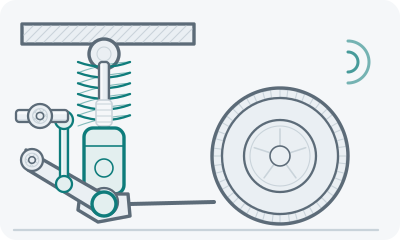
The suspension is the most talkative part of a car: almost every joint in it produces its own noise, in its own conditions, once it wears. That is exactly why it is convenient to check by ear — provided you do it in order rather than at random. Below is a checklist of five tests that take half an hour, need no lift, and almost always narrow the search to one or two parts.
Five tests, in order
1. The bounce test. Lean on each wing and let go sharply. A healthy strut brings the body back in one or one and a half movements. Three or more means the damper is not controlling it. A creak or a click during the bounce is a separate signal, pointing at the top mount or the spring.
2. Steering while parked. With the car standing, turn the wheel slowly from lock to lock. Clicking and crunching from the top of the strut is the top mount bearing. Knocking around the front end is track rod ends or the steering rack.
3. Small bumps. 20–30 km/h over expansion joints, cobbles and gravel, window down. This is where anti-roll bar links, bushes and worn control arm bushes are loudest: a dry, rapid knock, like pebbles in a tin.
4. Big bumps. Speed humps and potholes at 30–40 km/h. A dull single impact felt through the body is a damper, a bump stop or a ball joint.
5. Slalom and braking. Smooth lane changes at 60–80 km/h and braking from 60 to a stop. More body roll than usual and wallowing after the manoeuvre means dampers; a knock under braking means top mounts, ball joints or the brakes themselves.
The table of noises
| Sound and conditions | Most likely part |
|---|---|
| Dry, rapid knocking on small bumps | Anti-roll bar link, bushes |
| Dull impact in big potholes | Damper, bump stop |
| Creaking during the bounce test and slow potholes | Control arm bush, perished rubber |
| Clicking when steering while parked | Strut top mount bearing |
| Knocking when pulling away and braking | Ball joint, control arm bush |
| A hum that grows with speed | Wheel bearing or tyres |
The table helps you pick a theory; it does not replace the check. The same noise comes from different parts on different cars, and the last word belongs to an inspection on a lift with a pry bar. The full catalogue of road noises is on the symptom page knocking in the suspension.
What is not the suspension
Noises from elsewhere find their way into this checklist regularly. A knock you can hear with the car stationary and the engine running has nothing to do with the chassis. A rattle under the floor at particular engine speeds is usually a heat shield or exhaust mounts. A jolt and a knock as you pull away or change gear is more often the transmission and the engine mounts than the arms.
A useful rule: if the noise follows the road surface, it is suspension; if it follows drive and gear changes, it is transmission and mounts; if it follows engine revs while parked, it is the engine and its accessories. Three questions cut out most of the false theories.
What happens after the diagnosis
Two things are worth knowing before the repair is agreed. First, parts of the suspension are replaced in pairs across an axle — dampers and springs especially — because a new damper on one side and a tired one on the other makes the car behave differently left and right.
Second, wheel alignment after replacing arms, ball joints or bushes is not an optional extra. Those parts define the geometry, and skipping the alignment shows up as tyres eaten away within a few thousand kilometres. If a quote includes new arms but no alignment, that is a question worth asking before the work starts.
It also helps to write down what you found during the checklist and in which of the five tests, and to describe it in those terms — how to describe a car noise to a mechanic covers the wording that works.
Going through the checklist is easier with a recording: start one in the Pro-Stuk app while driving over bumps and answer the questions about speed and conditions. The app matches the sound against your answers and shows the likely causes with percentages — the list you bring to the mechanic comes out short and specific.
