

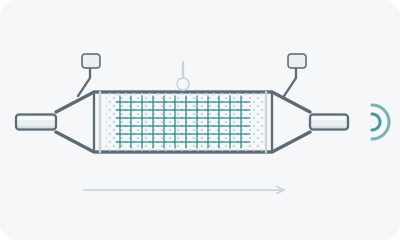
A broken catalytic converter has a voice of its own, unlike anything else. It is not a knock or a hum but a dry, pouring rustle from under the floor, easiest to describe as a handful of gravel rolling around in a tin can beneath the car. The sound appears over small bumps, when pulling away and when braking — and it is often the first clear signal that the ceramic honeycomb inside the housing has stopped being a single block.
Why the ceramic breaks up at all
Inside the converter sits a thin-walled ceramic block with hundreds of channels, held in a metal housing by a sealing mat. The material is strong in compression but brittle: it copes badly with impacts and with sudden temperature swings.
Three scenarios destroy it. The first is overheating: if unburnt fuel keeps reaching the exhaust because of misfires or over-fuelling injectors, it burns off inside the honeycomb itself and the temperature goes far beyond the design figure. The ceramic melts, loses strength and cracks. The second is a mechanical impact: hitting a rock or a high kerb, or a hard landing on a rough road. The third is thermal shock: a red-hot housing meets cold water and the block cracks from the difference. After that the gas flow grinds the fragments into debris, and the debris starts pouring about inside the housing.
Telling this sound from its neighbours
| Sound | When it is heard | Source |
|---|---|---|
| A pouring rustle | Bumps, pulling away, braking | Ceramic debris in the housing |
| Thin sheet-metal rattle | 1,500–2,500 rpm, idle | Heat shield |
| A low rumble, “tractor” note | Constant, louder on the throttle | A hole in a pipe or silencer |
| A ringing knock on the floor | Over potholes, when the body rolls | A slack exhaust hanger |
| Metallic grinding | Only when braking | Brake pads |
The practical check takes a couple of minutes. With the car cold, tap the converter housing with a rubber mallet or the flat of your hand: an intact block answers dully, a broken one with a characteristic dry rattling inside. The second method: with the engine warm, have a helper blip the throttle sharply a few times in neutral while you listen at the tailpipe — fine black debris may come out of it. The general catalogue of foreign noises from below is on the symptom page rattling under the car.
Why it matters
The rustle itself is harmless; its consequences are not. The fragments do not stay put: the gas flow pushes them towards the outlet, and sooner or later the debris packs into a narrow section and sharply raises exhaust back pressure. The car then loses power in the course of a single drive — acceleration dies away, the engine stalls under load, fuel consumption climbs.
The second risk applies to engines where the converter sits right against the exhaust manifold. When the throttle closes on the overrun, some of the abrasive debris can be drawn back into the cylinders and work there like sandpaper; that is one explanation offered for bore scoring on certain petrol engines. There are no guaranteed statistics here, but the risk is real, and it is another argument against dragging the repair out.
The third scenario is simpler: a destroyed converter stops doing its job, the rear lambda sensor registers it and the check engine light comes on. An emissions test will not pass with that fault stored.
How the repair is decided
The sensible order of steps: first a diagnostic scan, which shows codes for converter efficiency, mixture and misfires. Understanding the cause of the overheating matters, or the new part repeats the fate of the old one — a converter that failed because of misfires and a leaking injector will fail again in a year if only the converter is changed. Then an inspection of the whole exhaust on a lift: alongside the converter workshops often find a rotten silencer or a split flex pipe, and welding them all in one visit costs less than three separate visits.
The choice of part is the second fork. An original converter, an aftermarket one and a universal unit welded in differ in price, in how long they last and in whether the rear lambda sensor will accept them; ask which of the three you are being quoted and how the sensor will be handled. A quote that answers only “we will fix the noise” is worth a follow-up question.
If you hear the rustle but are not sure it is coming from the exhaust, record it in the Pro-Stuk app on a rough road and when pulling away. The app matches the recording with your answers to a few follow-up questions and shows the likely sources with percentages — which makes it easier to decide between going in urgently and booking a convenient day.
