

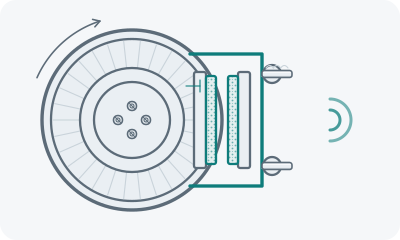
Brake pads are a consumable that wears invisibly: fractions of a millimetre over thousands of kilometres. But they report their condition by sound more honestly than almost any other part: most cars have a chirping indicator built into the pad itself. Below: which sounds correspond to which stage of wear, how not to confuse pads with a bearing or a stone behind the shield, and what the replacement involves.
How a pad announces its wear
A pad consists of a metal backing plate and the friction material — a layer of special compound 8–12 mm thick when new. It is the friction material that brakes, and as it wears the wear indicator comes into play. There are two types:
- Mechanical (the “squealer”) — a sprung steel tab on the backing plate. When the material is worn to about 2–3 mm the tab starts touching the disc and produces a thin metallic chirp. Cheap, reliable and fitted to most mainstream cars.
- Electronic — a contact sensor inside the material (typical of German brands). At the wear limit the contact closes on the disc and a light comes on. Such a sensor makes no sound — on those cars listen for other signs and trust the dash.
An important feature of the mechanical indicator: the chirp is heard on the move without braking or under light pressure, and fades under firm braking — the pad is pressed home and the tab stops vibrating. That is the main feature separating the indicator from other squeaks, described in detail in the brake pad wear indicator sound.
Sounds by stage of wear
| Sound | What is happening | Urgency |
|---|---|---|
| Occasional quiet whistle under light braking | The material is thin but there is margin | Plan an inspection |
| Constant metallic chirp on the move, fading under braking | The mechanical indicator has triggered, 2–3 mm left | Replace within days |
| Squealing at every stop in any weather | The material is worn or glazed, the disc may be scored | Inspection and most likely replacement |
| Coarse metal-on-metal grinding | The friction layer is gone, the backing is cutting the disc | Workshop immediately |
Grinding is the most expensive stage: within a few journeys the metal backing cuts grooves into the disc, and skimming or new discs join the bill. More on that sound is on the symptom page grinding when braking and in can you drive with grinding brakes.
How to listen properly
Brake sounds are heard best at low speed with the windows down — for example driving slowly alongside a wall, which reflects the sound and makes it easier to place. Make a few light stops and note three things: whether the noise is constant or only under pressure, whether it changes with pedal effort, and which side it comes from. Those three answers are half the diagnosis, and they are the first things a mechanic will ask.
What else squeaks besides worn pads
Not every brake noise means wear:
- Moisture and rust. After rain, a wash or a night outside the discs film over and the first 5–10 stops squeal. That is normal.
- Bedding in new pads. For the first two or three hundred kilometres after a change a light squeak is acceptable.
- A stone behind the shield. A stone caught between the disc and the dust shield gives a rhythmic grinding that follows speed rather than the pedal. It often appears after gravel, sometimes after wheel work.
- Hard budget pads. Some materials squeak throughout their life at normal thickness — unpleasant but not dangerous.
The general breakdown of squealing brakes with every branch of causes is on the symptom page squealing brakes.
Brake sounds should also be separated from a wheel bearing hum: a bearing hums evenly and low, the sound grows with speed and is not tied to the brake pedal at all. The simple rule: a sound that appears or changes under braking means the brakes; a sound that is constant with speed and ignores the pedal means the bearing and the tyres — its signs are in signs of a worn wheel bearing.
Checking pads without removing the wheel
- Look through the spokes. On most cars the outer front pad is visible from outside. Judge the thickness of the friction material, not the metal backing: less than 3 mm means replacement.
- Remember the inner pad. On many calipers it wears faster than the outer one, so the view from outside can be more optimistic than reality. The final verdict needs the wheel off.
- Brake fluid level. As the pads wear, the caliper pistons extend and the level in the reservoir slowly falls. A noticeably lower level with no signs of a leak is an indirect sign of worn pads.
- Rear drum brakes cannot be seen from outside at all — their condition is checked with the drum off, usually at a seasonal wheel change or a service.
Service life and how the job is decided
Front pads in town last roughly 30,000–50,000 km, rear discs one and a half to two times longer, drums longer still. That is a guide only: aggressive driving, constant full loads and towing cut it several-fold. Long descents are especially hard on pads — and on a descent it is better to brake with the engine in a lower gear than to hold the pedal, because overheated pads not only wear but temporarily lose their bite.
When replacing, ask the workshop to clean and grease the caliper slide pins and to assess the discs. That adds a little to the bill but saves you from squeaks and uneven wear on the new pads. Every disc has a minimum thickness stamped on it, and a workshop that measures rather than eyeballs it is answering the real question — whether the discs can stay or must be replaced with the pads.
If a brake sound is hard to classify by ear, record it in the Pro-Stuk app while driving slowly with a couple of light stops. The app matches the recording with your answers and shows the likely causes with percentages and an urgency level.
