

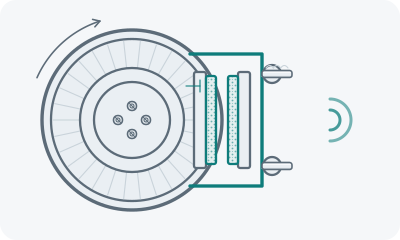
A brake squeal after rain or an overnight stand is one of the most common worries in the wet season. In most cases the sound is harmless and disappears after a few stops, but sometimes moisture only makes audible a problem that existed before the rain. Below: where the squeal comes from, how it is told apart from pad wear, and what to do if a repair is needed after all.
Where the squeal after rain comes from
A brake disc is an exposed cast iron part whose working surface has no protective coating: any coating would be scraped off by the first few stops. So damp air, rain or a wash covers the disc with a thin layer of rust within a few hours — the orange film is clearly visible through the wheel spokes by morning.
At the first applications the pads scrape that film off. Until the oxide layer is gone the friction coefficient wanders, and the pad-and-disc pair vibrates at high frequency — that vibration is what we hear as a squeal or a screech. Moisture also changes the behaviour of the friction material itself: a wet pad grips differently from a dry one, which adds to the sound.
There is a second mechanism. Water washes dirt and brake dust into the caliper carrier, where the pads move. If the slide pin grease is old, a pad can bind slightly after rain and rub on the disc even without the pedal.
When the squeal is normal
A harmless “wet” squeal has a recognisable signature:
- it appears in the morning after rain, a wash or simply a damp night;
- it is heard on the first 5–10 stops and then disappears completely;
- it shows more at low speed and under light pedal pressure;
- it comes with no change in pedal travel or stopping distance.
Brakes are equally normally noisy after standing for several days, after a frosty night with a humidity swing, and for the first two or three hundred kilometres after new pads while they bed in.
Rear drum brakes
On cars with rear drums, moisture shows differently: the drum is enclosed and water evaporates from it more slowly, so after rain the first applications can bring not a squeal but a dull moan or a slight grab — especially if the handbrake was used the day before. That also clears as things dry. A handbrake frozen after a wash in sub-zero weather is a separate story: do not pull away with a jerk, let the shoes thaw.
When the squeal is a signal
Be alert if the sound does not leave with the moisture. The main scenarios:
| Scenario | Likely cause | What to do |
|---|---|---|
| Squeal in the morning after damp, gone in 5–10 stops | Surface rust on the discs | Nothing — this is normal |
| Squeal at every stop in any weather | Worn or glazed pads, scoring on the disc | Inspect pads and discs |
| Thin metallic chirp on the move, fading under braking | The mechanical wear indicator has triggered | Replace pads within days |
| Coarse metal-on-metal grinding | The pad is down to its backing, the disc is suffering | Workshop without delay |
| Squeal with the car pulling under braking | A caliper sticking on one side | Brake diagnosis |
Grinding is fundamentally a different sound from a squeal: coarse and abrasive, it means metal on metal. That symptom is covered on grinding when braking and in can you drive with grinding brakes, while the general breakdown of squealing brakes is on squealing brakes and in brake squeal: pads or discs.
A special situation is a long stand in a damp place, a fortnight or more. The rust eats deeper, and the pads can stick to the discs. Then the first applications bring not only a squeal but judder through the pedal, and the film does not clear completely: pitting remains on the disc and skimming or replacement may be needed.
How to check it yourself
- The repeatability test. In a safe place, make a series of 10–15 moderate stops from 50–60 km/h. A “wet” squeal disappears by the end of the series; a wear squeal remains or grows as the brakes warm.
- Inspection through the spokes. On many cars the outer pad is visible without removing the wheel. Friction material under 3 mm (judge the material, not the metal backing) is a reason to book a replacement.
- When the sound appears. A chirp without the pedal that fades under braking is the wear indicator’s signature. The full breakdown by stage is in telling brake pad wear by ear.
- How the car behaves. Pulling to one side, pedal vibration, a longer stopping distance — signs that mean not postponing the visit at all; the caliper version is in signs of a seized brake caliper.
One clarification: if the squeal is heard over bumps and speed humps rather than under braking, the brakes are probably not involved — that is how anti-roll bar bushes and links behave, and tired dampers amplify any suspension noise. Their symptoms are in signs of worn shock absorbers.
What to do about it
If the squeal is the wet kind, nothing needs doing: it is the price of disc brake design, the same on budget and premium cars alike. If the sound is constant, the typical work is cleaning and greasing the caliper slide pins, replacing the pads, and skimming or replacing the discs where the measured thickness demands it.
Good practice is to combine a brake inspection with the seasonal wheel change: the wheels are already off and assessing the pads takes minutes.
There is prevention for the squeal itself. If the car sleeps outside in a damp climate, a simple habit helps: make a couple of calm stops at the end of a journey to dry the discs, and avoid leaving the handbrake on wet drum brakes for a long stand. It will not remove the morning squeal entirely — rust forms anyway — but the sound becomes quieter and shorter.
If you are unsure how to classify the sound, record it in the Pro-Stuk app — best in the morning, at the first applications, when the squeal is loudest. The app matches the recording with your answers and shows the likely causes with an urgency rating.
