

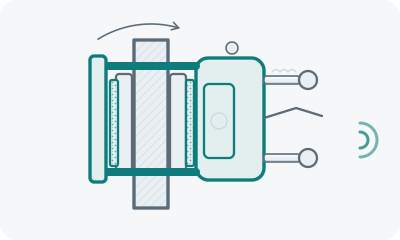
A caliper is the brake component that presses the pads against the disc when you press the pedal and should release them when you let go. “Seized” means it has lost that movement: the piston or the carrier’s slide pins have been gripped by corrosion and dirt. The problem is insidious because it develops over months and gives no obvious failure for a long time — the brakes “work, on the whole”. Below are the signs that identify a seized caliper without a lift, and what servicing involves.
Why calipers seize
A caliper lives in the worst conditions on the car: water, sand, road salt and heating to hundreds of degrees. All that protects it are the rubber boots on the piston and the slide pins. The chain is simple: a boot cracks, moisture gets in, corrosion follows, the part stops sliding.
Infrequent servicing speeds it up (the slide pins should be cleaned and greased at every pad change), as does old brake fluid, which has absorbed water and provokes rust inside the bore, and long periods standing — after a month parked outside, calipers seize especially readily.
Seasonality plays its part: the typical time to discover the problem is spring, after a winter on salted roads. Over the cold months corrosion does its work invisibly, and with the first warm, active drives the seized part shows itself as a hot wheel and pulling. So a spring brake check at the seasonal tyre change is not a formality but the cheapest way to catch the problem at the start.
The main signs
| Sign | What is happening | What has seized |
|---|---|---|
| Pulls to one side under braking | One caliper is not clamping fully | Piston or slide pins |
| Pulls to one side without braking | A pad is permanently pressed | The piston is not returning |
| One wheel hotter than the rest | A pad rubbing the disc | Piston or slide pins |
| A burning smell from a wheel | An overheated pad | Piston |
| Pads worn tapered or on one side | The carrier is skewed | Slide pins |
| The car coasts worse, consumption up | Constant light braking | Piston |
No sign alone is a verdict, but two or three together are an almost unambiguous picture. A sticking pad often gives a constant squealing brake noise or a rustle audible even without the pedal, changing as it heats. A metallic sound under braking is a reason to check pad thickness: a seized caliper eats them unevenly and fast — see grinding when braking and telling brake pad wear by ear.
How to check it yourself
- The temperature test. After 15–20 minutes of calm driving without heavy braking, hold a hand near each wheel (without touching the brake disc — it can burn). All the wheels should be similarly warm. One noticeably hotter puts that caliper under suspicion.
- The coasting test. On an empty level road, accelerate to 40–50 km/h and coast in neutral. If the car slows noticeably faster than it used to, or pulls to one side, something is dragging.
- Inspecting the pads. At a seasonal wheel change, compare the pads: on a healthy caliper the inner and outer wear at roughly the same rate. Tapered wear or a difference of one and a half to two times means seized slide pins — the detail is in signs of seized caliper slide pins.
- Listen after rain. A light film of rust on the discs after a damp night is normal and clears within a couple of stops. But a squeal from one wheel that lasts the whole journey is no longer about moisture.
What ignoring it leads to
A permanently pressed pad overheats the disc, and an overheated disc warps — judder appears under braking, felt through the wheel and the pedal, as covered in brake judder when braking. The pads wear out in a few thousand kilometres instead of tens of thousands.
The most dangerous scenario is a long mountain descent: a brake that is constantly heating boils the fluid, vapour forms in the circuit and the pedal sinks. That is not a theoretical risk on hilly routes, so a sticking caliper is one of the faults to fix before a long trip, not after it.
Front or rear: which seizes more often
Workshop statistics say the rear calipers suffer more often, for two reasons. First, the rear brakes work less than the front ones — they take a small share of the braking effort, so they clean themselves less well and warm up more slowly, and moisture lives in them longer. Second, on many cars the parking brake mechanism is built into the rear caliper: an extra assembly with its own mechanics, which infrequent use of the handbrake only harms. Owners of automatics who go years without touching the handbrake know the scenario: once applied in frost, it will not let the wheel go.
The practical conclusion: use the handbrake regularly rather than on high days and holidays, and ask for the rear calipers to be inspected at every pad change — even if only the front ones are bothering you.
How the repair is decided
Restoring costs several times less than replacing, so a decent workshop first assesses the state of the piston and bore rather than offering a new unit by default. Ask what the bore looked like: pitted corrosion means replacement, a sound surface means a rebuild kit.
Two more things. Whether the correct rubber-safe, high-temperature brake grease is being used on the pins and the piston seal — ordinary chassis grease destroys the boots and the fault returns within a season. And whether the brake fluid is due: fluid that has absorbed moisture is what corrodes the bore from inside, so a caliper rebuild with the old fluid left in is half a job.
The cheap prevention is asking for the slide pins to be greased at every pad change: it adds little to the work and postpones seizure by years.
If the brakes have started sounding unfamiliar and the cause is not obvious, record the sound in the Pro-Stuk app while driving. The app matches the recording with your answers about when the sound appears and suggests the likely causes and how urgent they are.
