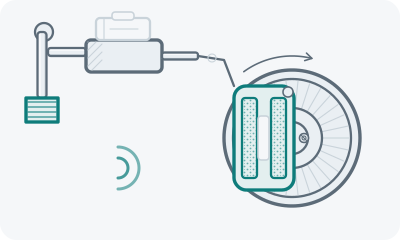
- 1master cylinder
- 2brake line
- 3brake disc
- 4brake caliper
- 5brake pedal
- 6brake pad
Brake squeal and grinding
37 guides in this section
Brakes are the one system where the sound is meant literally: most of the signals here were designed in by the manufacturer. The metal wear indicator starts squealing on purpose when the pads are near their limit, and metal-on-metal grinding means the limit has already passed.
At the same time the most common cause of squealing is harmless: the film of rust that forms on the discs overnight and is scraped off within the first few stops. This section covers how to tell the normal from the warning, and the warning from the point where you stop driving as usual.
Wheel and hub noises belong here too: bearing hum, vibration at speed, clicking and steering-wheel judder — all of them are regularly mistaken for brake problems.
Where the noise comes from
wheel brake assembly
Narrow the sound down by questions
An interactive diagnosis tree: a few questions and the list of causes gets much shorter.
All articles in this section
- A driveline clunk on and off the throttle A dull thump the moment you lift off or get back on the throttle is driveline clearance being taken up. Which parts knock and how to tell them apart.
- A hum after changing tyres A hum at speed appeared after a tyre change. When the tread is to blame, when it is balancing or wheel rotation, and when the tyres are innocent.
- A hum on the motorway that vanishes in town Why a hum is only audible above 80 km/h and disappears around town: wheel bearings, tyres, aerodynamics and the order of checks you can do yourself.
- A hum that grows with speed A hum that rises with road speed almost always comes from the wheels. How to separate a wheel bearing from tyres and the transmission in a single drive.
- A knock after a tyre change: what to check Where a knock after a tyre change comes from: wheel torque, balance weights, stones in the tread, a bent rim. What to check yourself and when to go back.
- A knock felt through the brake pedal Knocking and feedback through the brake pedal can be normal ABS operation, or play in the caliper or the running gear. How to tell them apart.
- A knock when braking: pads or caliper A knock as you press the pedal comes from both moving pads and a loose caliper. How to tell them apart by the character of the sound.
- Automatic transmission whine: the early signs Whine from an automatic gearbox at an early stage: what it sounds like, how it differs from wheel bearing and tyre noise, and what gets checked first.
- Brake pad wear indicator: what it sounds like A thin metallic squeal while driving that stops the moment you brake is the mechanical pad wear indicator. How to recognise it and how long you have.
- Brake squeal after rain: normal or not Why brakes squeal after rain and an overnight stand, when it is harmless rust on the discs and when it is a sign of worn pads.
- Brake squeal after standing: normal or not A morning brake squeal after a night outside is usually rust film on the disc. How to tell it from worn friction material and when to go to a workshop.
- Brake squeal at low speed A brake squeal at 5–20 km/h can be harmless pad vibration or the wear indicator doing its job. How to tell them apart and what the repair depends on.
- Brake squeal: pads or discs Brakes squeal because of the pads and because of the discs. How the conditions in which the sound appears tell you which one to replace.
- Can you drive with grinding brakes Metallic grinding when braking means the friction material is gone and metal is cutting the disc. How far you can drive, what not to do and what it costs.
- Checking hub play with the wheel raised How to raise a wheel safely and check for play: the 12–6 and 3–9 grips, how to separate the bearing from the ball joint and steering, and what to do next.
- Clicking from a wheel while driving Rhythmic clicking in time with wheel rotation: a stone in the tread, a screw, a wheel trim or the brake disc. How to find the source and when not to drive.
- Clicking: CV joint or brakes Clicking in turns and when pulling away comes from both the outer CV joint and the brakes. How to separate the theories by the conditions.
- Gearbox whine in neutral A whine in neutral with the clutch up usually points to the input shaft bearing or the oil level. How to tell it from the release bearing in one pedal test.
- How far a wheel bearing lasts after the hum starts From a wheel bearing's first hum to dangerous play is usually thousands of kilometres. What the margin depends on and which signs cancel it.
- How to check a brake caliper for sticking The signs of a seized brake caliper: the coasting test, checking wheel temperature, pulling under braking and the smell. What a workshop does about it.
- How to check a wheel bearing yourself Five checks that identify a worn wheel bearing and its side without a lift: tests on the move, raising the wheel, checking play and hub temperature.
- Humming under the bonnet at idle What hums under the bonnet at idle: the cooling fan, alternator, A/C compressor, water pump or idlers. Simple switch tests that locate the source.
- Humming when turning left A hum when turning left usually means the right wheel bearing is worn. Why that is, how to confirm it in one drive and how urgent the replacement is.
- Humming when turning right If the hum grows in right-hand curves, the left wheel bearing is the suspect. A step-by-step check without a lift, the sound-alikes and what the repair involves.
- Humming: the gearbox or a wheel bearing A hum at speed comes from both wheel bearings and gearboxes. Three tests that separate them in a single drive, and what each answer means for the repair.
- Humming: wheel bearing or tyres — telling them apart How to tell wheel bearing hum from tyre noise: tests you can do in one drive, a comparison table of the signs, and the mistakes that cost money.
- Lada gearbox noise: fifth gear whine A whine in fifth gear on a Lada gearbox: why the top gear is the one that goes, how to tell gearbox noise from a wheel bearing, and what to check.
- Noises after a brake pad change: what is normal New pads almost always make noise for the first few hundred kilometres. Which sounds belong to bedding in and which point to a fitting error.
- Renault Duster transfer case whine A whine from under a four-wheel-drive Duster: how to tell the transfer case and rear differential from a wheel bearing and tyres, and what gets checked.
- Rustling from a wheel at low speed A rustle from a wheel at 10–30 km/h most often comes from the brakes or the dust shield. How to tell a harmless touch from wear, and what to check.
- Signs of a seized brake caliper How to tell a brake caliper has seized: pulling to one side, a hot wheel, a burning smell, grinding. Simple checks without a lift and what servicing involves.
- Signs of a worn wheel bearing How a worn wheel bearing sounds, how to tell it from tyre noise, which tests you can do yourself and what decides the replacement.
- Signs of seized caliper slide pins One wheel running hot, the car pulling under braking, pads worn unevenly — how to recognise seized caliper slide pins and what a workshop does about it.
- Telling brake pad wear by ear The sounds worn brake pads make: the wear indicator chirp, squealing, grinding. How to tell them from a wheel bearing hum and what to check.
- Vibration and hum at 100 km/h Where vibration and hum at 100 km/h come from: balancing, a bent rim, a wheel bearing or tyre noise. Self-checks you can do in one drive.
- What a failing wheel bearing sounds like From a faint hum at 60 km/h to a roar and vibration in the wheel — how a wheel bearing changes its sound stage by stage, and where you can no longer wait.
- Working out where a hum comes from: front or rear Simple tests that identify the axle and the side a hum comes from: lane changes, coasting, swapping wheels and a drive with a passenger.
Other sections

Pro-Stuk
Do not guess from articles — record the sound. The app matches the recording against your answers and names the likely causes with percentages.
- · the questions a mechanic would ask
- · analysis of a 15–30 second recording
- · an urgency traffic light