

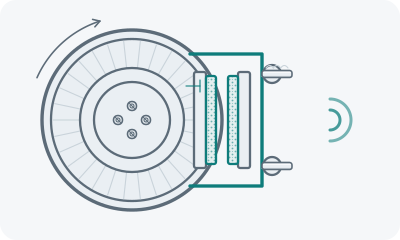
The car has stood overnight, the first stop as you pull out — and the front wheels give a drawn-out squeal, as though the friction material had worn away in a single night. A block later the sound is gone and nobody thinks of it until the next morning. That picture is familiar to owners whose cars live outside, and in the vast majority of cases it needs no repair. What is worth understanding is one thing: how to tell the morning film from genuine wear, so you do not miss the moment when a familiar sound has become a new one.
Why a disc rusts overnight
A brake disc is an exposed cast iron part with no coating: any coating would burn off at the first stop. Cast iron reacts to airborne moisture instantly, and within a few hours of standing an oxide film microns thick appears on the working face. In autumn, spring and after rain the process is faster; in dry heat, slower.
That film changes the friction coefficient and makes the contact uneven: the pad catches on it irregularly, starts vibrating, and the vibration becomes a squeal. The first applications clear the film, the surface evens out and the sound goes. The mechanism is the same as for any brake squeal — resonance of the pad-and-disc pair — covered on the symptom page squealing brakes.
Normal and concerning versions
| Picture | What it means |
|---|---|
| Squeal on the first 2–3 stops, then silence | Film after standing, normal |
| Squeal worse after rain and in damp weather | The same film, amplified by moisture |
| Squeal lasts the whole journey | Worn pads or a seized caliper |
| Metallic grinding added to the squeal | The material is gone, the disc is being cut |
| Squeal from one wheel, that disc runs hot | A sticking pad |
| Squeal after a month standing, with grabbing | Deep corrosion, the disc needs checking |
The first two rows are a reason to watch rather than to repair. The third and below mean the mechanism needs servicing. The one hot wheel deserves particular attention: a sticking caliper heats the disc, the brake fluid and the hub assembly, and the consequences go beyond the brake system.
Checking yourself in one journey
- Count the stops. Count the first five to seven applications and note which one the squeal disappeared on. Consistently the second or third means normal.
- Compare the weather. Note how the car sounds on a dry day and after rain. The film depends noticeably on humidity; wear does not.
- Check on warm brakes. If after an hour of town driving the squeal returns unchanged, standing is not the cause.
- Check the temperature. After calm driving with little braking, judge the disc temperatures: one noticeably hotter wheel points at the caliper.
- Inspect the friction material. Under 3 mm means a new set regardless of the sound.
If the checks reveal that the squeal comes with shaking through the steering wheel, that is a different story — it is about disc geometry, covered in brake judder when braking. And if the sound has become lower and turned into an even hum that grows with speed, read a hum that grows with speed — that is a wheel bearing rather than the brakes.
What to do about it
A morning squeal that fits into two or three stops is not cured — and does not need curing. Small things prolong the silence: do not wash the car at night, do not leave it standing with wet brakes for long, and after a wash drive a little and brake a couple of times to dry the discs. If the car stands for months, driving a few kilometres every couple of weeks helps.
When the checks point at wear, the work is the familiar list: an inspection, new pads, a caliper service with the slide pins cleaned and greased, and skimming or replacing discs where the measured thickness requires it. The one question worth asking is the disc’s number — every disc has a minimum thickness stamped on it, and that figure, not an opinion, decides whether it stays.
The boundary between “normal morning squeal” and “time for a workshop” runs through the character of the sound, and those shades are poorly remembered: a month later it is hard to say whether it squealed the same or slightly harder. A recording made in the Pro-Stuk app today and repeated a few weeks later shows that difference objectively — along with a list of likely causes and an assessment of how urgently to book a diagnosis.
