

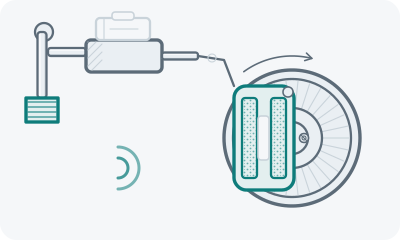
A hum that appears quietly around sixty kilometres an hour and turns into an even low howl by a hundred is such a common complaint that almost any mechanic has heard it today. The value of this symptom is that it rules out half the car immediately: if the sound follows road speed rather than engine revs, the source rotates with the wheels. What remains is to work out which part — and three simple tests, done in a single drive, do most of that work.
Speed or revs: the first fork
The key distinction is this: some parts rotate with the speed of the car, others with engine revs. Checking which is simple. Accelerate to the speed where the hum is clearly audible and select neutral without touching the throttle. If the sound is unchanged while the car coasts, it is born in the chassis or in the transmission after the gearbox. If it disappears along with the drive, look closer to the engine: accessories, the water pump, idlers.
The second level of the check is consistency. Take one speed — 80 km/h, say — and hold it first under power, then coasting, then with light engine braking. Bearing hum barely changes; transmission hum reacts noticeably to load; tyre noise stays even but changes with the road surface.
Telling a bearing from tyres
| Sign | Wheel bearing | Tyres |
|---|---|---|
| Reaction to lane changes | Changes volume | No change |
| Change of road surface | The same sound | Changes noticeably |
| Coasting in neutral | Hum remains | Hum remains |
| Tone | Even howl, later a rumble | Rustling, swishing |
| How it appeared | Gradually, over months | Often right after a tyre change |
| Vibration in the steering | Possible at a late stage | Rare |
The main tool here is the lane-change test. On an empty straight road at 60–80 km/h, ease left, then right. Turning left transfers weight onto the right-hand wheels, and the right bearing hums louder; turning right gives the mirror image. Tyres barely react to those manoeuvres.
What else hums at speed
Besides bearings and tyres, the list holds the transmission and aerodynamics. A differential or gearbox produces a hum tied to speed but sensitive to drive: louder under power, quieter coasting, and at certain speeds it can turn into a distinct whine. Wind noise — a badly seated door seal, a loose arch liner, a trim strip — is recognised by its abrupt onset: it arrives almost in a step as you cross a particular speed and does not change during lane changes.
A frequent scenario of its own is a hum that does not exist in town and appears only on the motorway; it is covered in a hum on the motorway that vanishes in town. The full catalogue of speed-related sounds, with examples of their tones, is on the symptom page humming while driving.
What the diagnosis and repair involve
The diagnosis starts on a lift: the wheels are raised and spun by hand while the mechanic listens for noise and checks for play. It is a quick procedure.
If a bearing is confirmed, two things shape the job. The first is whether your car uses a separate bearing that is pressed into the existing hub or a complete hub assembly replaced as a unit — that decides both the price and the time. The second is the hub nut: its tightening torque matters more here than on most work, because an over- or under-tightened nut destroys a new bearing within thousands of kilometres. A torque wrench rather than an impact gun is what you want to see.
If the wheels turn out to be the cause, the answer is usually cheaper — balancing, or rotating and in some cases replacing tyres whose tread has gone sawtooth. Uneven wear itself is worth investigating, though: it usually means alignment is out or the dampers are tired, and new tyres on an unfixed car go the same way.
A wheel bearing almost never fails instantly, but do not ignore the hum for months: the next stage is a rumble and vibration, and after that the cage breaks up and the wheel develops play. A sensible horizon is an inspection within two weeks of the sound becoming permanent.
The difficulty is that all these tests are done by ear while driving, and human memory for sound is short. Record the hum in the Pro-Stuk app at different speeds and during lane changes: it matches the recordings with your answers and shows the likely causes with percentages, so the conversation at the workshop starts with a specific theory.
