

A rhythmic click-click-click that speeds up along with the car is one of the few car sounds whose source you can find yourself in five minutes on the driveway. That rhythm means something is touching or striking once per wheel revolution. The list of candidates is short and most of them are harmless. But some call for stopping, so it is better to look into it straight away rather than “when there is time”.
Why the clicking is rhythmic
The frequency of the sound is tied to wheel speed. At 30 km/h a wheel turns about four times a second and the clicking is heard as separate clicks; at 80 km/h they merge into a chatter or even a rasp. Hence the first rule of checking: if the intervals between clicks shorten proportionally as speed rises, the source rotates. If the rhythm does not change or the sound is chaotic, look elsewhere — at the suspension, the undertray fasteners or the exhaust.
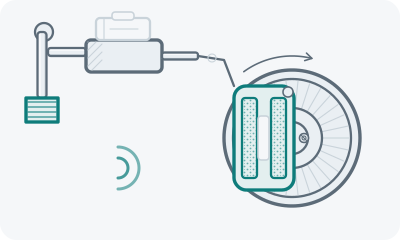
The second guide is the reaction to braking. Clicking that grows or disappears under light pedal pressure almost certainly comes from the brake mechanism: the carrier, a pad spring or a distorted disc. Clicking indifferent to the brakes is the wheel: tread, rim, trim, balance weight.
What usually clicks
| Source | How it shows itself | What to do |
|---|---|---|
| Stone in a tread groove | Clear click, goes by itself | Prise it out with a screwdriver |
| Screw or nail in the tyre | Metallic sound, pressure falling | To a tyre shop |
| A balance weight that fell off | Clicking plus steering wheel shake | Rebalance |
| Wheel trim or arch liner touching | Plastic tone, changes in corners | Inspect, secure |
| A score on the brake disc | Sound in time, reacts to the pedal | Inspect the disc |
| Stone between disc and shield | Grinding click, heard at low speed | Remove it, inspect |
The inspection order is simple. Roll the car forward a couple of metres to bring a new part of the tread round, and look over the contact patch all the way round — stones and screws are visible at once. Then look into the gap between the brake disc and its shield: gravel often gets in there and gives a grinding click, especially at low speed. Check the wheel trim: take it off and drive round the block. The sound has gone — question closed.
When clicking means more
There are three scenarios where nothing should be postponed. First, clicking together with falling tyre pressure: air is escaping, and at speed that can end with the tyre coming off the rim. Second, clicking combined with steering wheel vibration and a longer brake pedal travel: a distorted disc or a binding caliper is possible — brake judder when braking. Third, a metallic grinding sound that grows as you turn — there the hub assembly is already under suspicion, signs of a worn wheel bearing.
If an even rustling accompanies the clicking at low speed, it is worth reading rustling from a wheel at low speed: those symptoms often come together. And if squealing under braking has joined the clicking, the situation is described in brake squeal at low speed. The catalogue of sounds arriving from below, with examples and a check order, is on the symptom page rattling under the car.
How the repair is decided
The good news: most causes of clicking are among the cheapest repairs on a car — a stone prised out, a trim clipped back on, a wheel rebalanced, a puncture plugged. What decides the work is which side of the brake test you fall on: sounds indifferent to the pedal belong to the wheel and are usually settled at a tyre shop, while sounds that answer the pedal belong on a lift.
Two things worth knowing. If a screw is found, ask where it sits: a puncture in the tread is repairable, one in the sidewall or shoulder is not, and a shop that repairs it anyway is selling you a tyre that will fail later. And if a disc is scored, ask whether it has enough thickness left to machine — below the minimum stamped on the disc, machining is not an option and a new disc is the only honest answer.
It is also worth agreeing a deadline with yourself. A stone falls out within a day or two, and if the clicking is still there a week later the “just a pebble” theory no longer works — time for a lift.
If you could not find the source by eye and the sound is only audible on the move, record it in the Pro-Stuk app while driving through a quiet courtyard with the window down. The app matches the recording with your answers about speed and the reaction to the brakes and shows the likely causes with percentages — and suggests which wheel to inspect first.
