

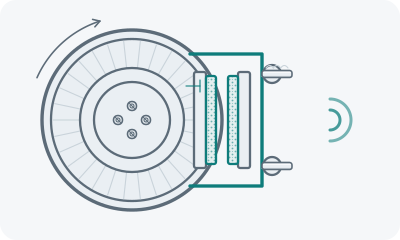
The thin high squeak as you roll up to a traffic light is familiar to almost everyone: the car has nearly stopped, the pedal is barely pressed — and the front wheels produce a squeal audible even to passers-by. The sound is unpleasant, but in itself it does not mean the brakes are faulty. A squeal is born of vibration, and vibration in the pad-and-disc pair arises on new and worn mechanisms alike. What is worth working out is not the fact of the squeal but the conditions in which it appears.
Where the sound comes from
The pad presses against the rotating disc, friction arises between them, and any friction is a series of microscopic grabs and releases. If the frequency of those releases coincides with the natural frequency of the pad or the caliper, the assembly starts to resonate like a bow on a string. The result is a squeak in the 2–15 kHz range, at the upper edge of the sounds a car usually makes.
It follows that the squeal depends on the stiffness of the friction material, the clamping force, the temperature and the state of the disc surface. At low speed all four factors come together unfavourably most often — the clamping is light, the brakes are cold, and there may be a film of moisture or dust on the disc. That is exactly why the same car is silent in an emergency stop from 90 km/h and squeaks rolling up to a gate.
When the squeal is harmless and when it is not
| Conditions | What it most likely is |
|---|---|
| The first 2–3 stops in the morning or after rain | Surface rust on the disc, normal |
| The first 200–500 km after a pad change | The new set bedding in |
| Only under light pressure, gone under hard braking | Pad vibration, a cosmetic problem |
| Constantly, at any pedal pressure | Worn friction material or a seized caliper |
| The squeal has turned into grinding metal | The material is gone, the disc is being cut |
| Squealing without touching the pedal | The wear indicator or a binding pad |
The first three rows need no repair — at most grease on the slide pins and anti-rattle shims. The last three mean a workshop visit should be planned: at best it ends with a set of pads, at worst discs join them. How the different stages of wear sound is covered on the symptom page squealing brakes and in telling brake pad wear by ear; the morning and wet-weather cases have their own breakdowns in brake squeal after standing and brake squeal after rain.
What to check yourself
The easiest place to start is observation rather than a spanner. Three drives in a row give almost the whole picture:
- A cold morning start. The squeal is there on the first few stops and then disappears — moisture and surface rust, question closed.
- Different pedal pressures. It squeals only on light contact — vibration; it squeals under hard braking too — mechanics.
- Squealing without the pedal. The sound comes while coasting — the metal wear indicator is doing its job: a thin tab that starts touching the disc when the friction material has worn to its limit.
A visual inspection adds confidence. Take the wheel off and judge the thickness of the friction material through the caliper window: less than 3 mm means a set due for replacement. It is worth comparing the left and right wheels: a difference of more than a couple of millimetres says one caliper is working worse than the other. If judder in the pedal or shake in the wheel has joined the squeal, read a knock felt through the brake pedal and brake judder when braking — those are about disc geometry rather than pad noise. Whether the squeal comes from the pads or the discs is separated in brake squeal: pads or discs.
How the repair is decided
The practical order is this: first a service of the mechanism — stripping, cleaning and greasing the slide pins — and only then new parts. Replacing a set of pads because of a squeal without checking the slide pins is a well-known way of paying twice: new friction material on a seized caliper squeals just the same, signs of seized caliper slide pins.
Two things worth asking for when pads are replaced. That the fitting kit — shims and springs — goes in with them: those parts are what stops the pad vibrating, and they are often left in the box. And that the state of the discs is assessed at the same time, because worn or grooved discs give the same squeal back on new pads.
One more thing mechanics do not always mention: a new set needs bedding in. Several dozen moderate stops from 60–80 km/h without hard braking or long stationary pauses with the pedal held down — that is what forms an even transfer layer on the disc and removes half the future noise. If the squeal has turned into grinding, the question is no longer about noise — see can you drive with grinding brakes.
If you want to know what is actually sounding before booking anything, record the squeal in the Pro-Stuk app while rolling up to a light. The app breaks the recording down by frequency, matches it with your answers to a few questions about the conditions and shows the likely causes with percentages — usually enough to decide between going now and waiting for the next service.
