

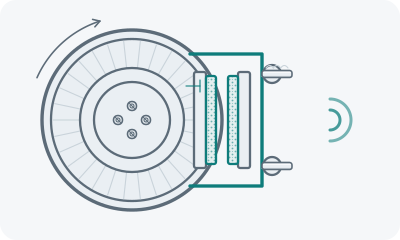
Squealing under braking is the most common and most ambiguous sound the brake system makes. It can be entirely harmless, or the last warning before an expensive repair, and the two are told apart not by loudness but by the conditions in which they appear. The mechanism is simple: pads with friction material are pressed against a rotating disc, and any disturbance in the contact between them turns into high-frequency vibration — what the ear hears as a squeal. The task is to work out whether the contact is disturbed on the pad side or the disc side.
When the pads are to blame
Pad squeal has several typical scripts. The first is the friction material worn down to the metal indicator: a thin tab deliberately touches the disc and produces a sharp chirp, audible while driving and disappearing when you press the pedal. That is a direct instruction to book a replacement — the detail is in the brake pad wear indicator sound.
The second script is new or hard friction material. Ceramic and semi-metallic compounds are noisier than organic ones, especially on cold brakes and under light, trailing pressure. The third is the fitting: forgotten anti-rattle shims, no grease on the pad backs and the caliper slide pins produce vibration even on a healthy disc.
When the disc is to blame
A disc announces itself differently. Surface rust after standing gives a brief squeal on the first few stops. A worn disc with a lip at its edge squeals at a particular pedal position and often comes with pulsing. An overheated disc with a changed surface structure is consistently noisy and usually brings vibration through the steering wheel.
| Condition | More likely the pads | More likely the disc |
|---|---|---|
| In the morning, first stops | — | Rust film, gone in 2–3 applications |
| Constantly under light pressure | Hard material, wear | — |
| With the pedal released | Wear indicator, seized slide pins | — |
| Together with pedal vibration | — | Run-out, uneven thickness |
| Only after new pads | Fitting, missing grease | — |
| Grinding rather than squealing | Material worn to the backing | Scoring on the face |
Grinding is its own category: it means metal-on-metal contact and calls for a repair rather than more diagnosis. The full breakdown of this group of sounds is on the symptom page squealing brakes and in telling brake pad wear by ear.
The order of checks
Start simple: count how many stops it takes for the sound to go. Two or three means almost certainly a film on the disc. Never means look at the pads. Then judge the friction material’s thickness through the wheel spokes: under 3 mm is replacement territory. Run a finger along the disc’s edge: a palpable lip a millimetre or more high means serious wear.
It is worth checking the caliper too: a seized slide pin holds the pad against the disc permanently, and then the squeal comes with the pedal released and the wheel is noticeably hotter than the others after a drive — see signs of a seized brake caliper. The same “compare sides and conditions” logic works elsewhere too — for instance separating gearbox hum from a hub in humming: gearbox or wheel bearing, and tyre noise from a bearing in humming: wheel bearing or tyres.
How the repair is decided
The practical rule is: take the wheel off and look first, then work out the cost. A squeal that a slide pin service would have cured often turns into new discs simply because the visit was postponed for six months.
Two things worth insisting on. That the disc is measured against its stamped minimum thickness rather than judged by eye — that single number decides between skimming, keeping and replacing. And that the fitting kit goes in with the pads: shims, springs and the correct high-temperature grease are what stop a fresh set squealing from day one.
If the sound does not appear every time and is hard to catch on the ramp, record it in the Pro-Stuk app while driving — with and without the pedal. The app matches the recording with the conditions in which it appears and shows the likely causes with percentages, so the conversation with a mechanic starts from facts.
