

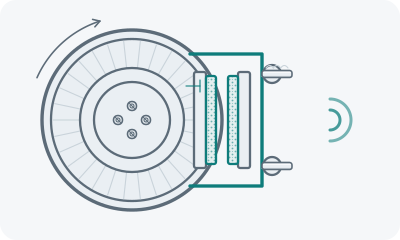
A thin metallic squeal that appears while driving and disappears the moment you press the brake alarms a lot of drivers — the sound is unpleasant and clearly made of metal. In fact it is the friendliest signal a braking system knows how to give: the mechanical pad wear indicator has engaged. It warns you in advance, while the disc is still intact and the replacement costs ordinary money.
How the indicator works
A bent spring tab is attached to the steel backing plate of the pad. While there is enough friction material, it does not reach the disc and makes no sound. As the pad wears thinner, the edge of the tab starts touching the rotating disc. Metal on metal at speed produces not a grinding noise but a high-frequency squeal — rather like a fingernail on glass, only louder and steadier.
The engagement point is chosen so that the driver has a margin: the tab usually reaches the disc when about 2–3 mm of friction material is left. That is not yet an emergency, but it is a direct invitation to book an appointment.
The second variant is an electrical sensor: a wire loop routed into the body of the pad wears through against the disc and breaks the circuit, lighting a warning on the dash. That system does not squeal at all, so the absence of the sound proves nothing by itself.
Telling it from other squeals
| Sound | When you hear it | What it is |
|---|---|---|
| Even high squeal | While rolling, stops when you brake | Wear indicator |
| Squeak under light braking | Only when braking, often in the morning and in damp | Film on the discs, dust, pad compound |
| Grinding and growling | When braking, felt through the pedal | Pads worn to the metal |
| Squeal under the bonnet | Follows engine revs, louder when cold | Accessory belt |
| Constant squeal from one wheel | Ignores the pedal, the disc gets hot | A sticking caliper |
The main divider is how the sound reacts to the pedal. The indicator squeals while rolling and falls silent under braking; most other brake squeaks do exactly the opposite. If the sound does not care whether the car is rolling or standing with the engine running, look at the accessories rather than the brakes. The full picture of brake squeal is on the symptom page squealing brakes.
What to check before replacing
The inspection takes little time and saves money. Through the wheel spokes you can usually see the thickness of the friction material — if only a thin strip a little thicker than the steel backing is left, the question is settled. Three more things are worth a look while you are there.
First, whether the wear is even: if the inner pad is noticeably more worn than the outer, the caliper is not working properly and new pads alone will not be the end of it. Second, the condition of the disc: a lip around the edge and deep grooves mean new pads will not bed in properly. Third, the other axle — rear pads usually last longer, but checking them at the same time is logical.
Pads are replaced as a set across an axle even if only one wheel squeals: different thicknesses left and right cause pulling under braking.
How the repair is decided
Two questions decide the scope. Whether the discs stay: they have a minimum thickness stamped on them, and a disc below it is replaced rather than reused, however good the pads are. And whether the caliper needs servicing: if the wear was uneven, cleaning and lubricating the slide pins belongs in the same visit — otherwise the new pads wear the same way within months.
One thing workshops do not always mention: new pads and discs need bedding in. For the first two or three hundred kilometres, avoid emergency stops and long descents held on the pedal, so the friction material beds in evenly.
If the sound has appeared and you are not sure whether it is the indicator or something else, record it in the Pro-Stuk app — first while coasting, then with light braking. The app matches the recordings with your answers and shows the likely causes with percentages.
