

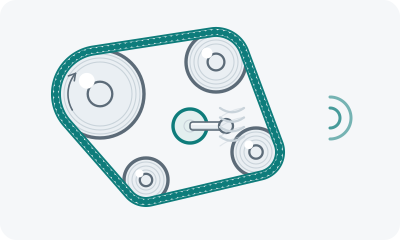
A squeal from under the bonnet is one of the most recognisable car sounds, and its source is almost always the drive belt. Out of habit it is called the alternator belt, although on most modern cars a single multi-rib belt turns several units at once: the alternator, the water pump, the power steering pump and the air conditioning compressor. Here is where the squeal comes from and how the moment it appears narrows the list of causes.
Where the squeal comes from
The belt transmits rotation through friction: the tensioner presses it against the pulleys, and normally the rubber rolls over the metal without sliding. When there is not enough grip — because of slack tension, worn ribs or a slippery surface — the belt starts to slip. The rubber vibrates against the pulley at high frequency, and you get that yelp, like a wet palm on glass.
Hence the main conclusion: a squeal is not the character of a particular belt but a symptom of lost grip somewhere in the drive. The general description of the symptom and its twins is on the page belt squeal.
The main causes
| Cause | How it shows itself | What to do |
|---|---|---|
| Slack tension, tired tensioner | Squeal under load: starting, a/c, steering | Check the tension, replace a worn tensioner |
| Belt wear: cracks, glazed ribs | Squealing more often, audible when warm too | Replace the belt |
| Oil or coolant on the pulleys | A floating squeal, oily film on the belt | Find and fix the leak, replace the belt |
| Worn idlers, rusty pulleys | Rustle or hum joins the squeal | Replace the idlers, clean the pulleys |
| A driven unit binding | Sharp yelp, possible smell of burnt rubber | Diagnose the unit, repair |
| Water after a puddle or a wash | Brief yelp, goes by itself | Watch; no treatment needed |
On fluids specifically: an oil-soaked belt cannot be saved by cleaning — the rubber has already absorbed it and the squeal will return. What matters is finding the source. Engine oil usually comes from the seals or the cam cover, while coolant most often comes from the water pump: its worn seal weeps right next to the pulleys. The signs of that fault are collected in signs of a failing water pump.
What the moment of the squeal tells you
The timing of the sound is half the diagnosis:
- A few seconds after starting, when cold. Stiffened rubber plus morning condensation. An early stage: the belt or the tension is already at its limit, but the car is silent during the day. More in squealing under the bonnet when cold and on the symptom page squeal on startup.
- In rain and damp. Water on the pulleys reduces friction. A fresh belt with a healthy tensioner survives the damp in silence; a worn one yelps.
- When the air conditioning engages or the wheel is turned. The compressor and the power steering pump add load. If there is no tension in reserve, the belt breaks into slipping at exactly those moments.
- Constantly, in every state. A late stage of wear, serious oil contamination, or a binding unit. That should not be dragged out.
Winter adds its own scenario: in hard frost even relatively fresh belts squeal, because the rubber loses its flexibility and there may be frost on the pulleys. If the sound goes after a minute of warm-up and does not return during the day, it is too early to panic — but an inspection at the first convenient opportunity will not hurt.
There is an indirect sign unconnected with sound. Heavy slipping is not only a yelp. The alternator turns more slowly than it should at those moments, and the electrical system gets less current. The symptoms are visible without instruments: the headlights dim at idle when the heaters come on, the stereo restarts, the battery light occasionally flickers. If the squeal comes with oddities like that, the check should definitely not be postponed — the next stage is a flat battery at the least convenient moment.
How to check it yourself
Four steps, possible without a pit or tools:
- Inspect the belt with a torch. Cracks across the ribs, a shiny glazed working face, fraying and delamination at the edges are signs of wear. Turn the belt in sections only with the engine off.
- Look for traces of fluids. An oily sheen on the belt, runs down the block, rusty or whitish coolant traces near the water pump pulley.
- Check the tension. On cars with manual adjustment the belt should deflect roughly 5–10 millimetres under finger pressure on the long run. An automatic tensioner is checked by its wear marks and by whether its pulley flutters with the engine running.
- Inspect the pulleys. Rust, deep wear in the grooves, caked dirt — all of it reduces grip even with a new belt.
If the belt looks healthy but the squeal is even and rises with revs, the source may be a bearing rather than rubber. How to separate them without dismantling anything is in a squeal: the belt or an idler bearing.
How the repair is decided
The practical rule: if the belt is being replaced because of wear, the idlers and the tensioner should at least be checked for play and noise — stripping the same assembly again a month later costs more than doing both at once.
Two things mechanics do not always say. The tensioner spring is what actually sets the grip, and it tires invisibly: a belt fitted to a tired tensioner squeals again within weeks, so ask whether the tensioner’s pointer sits within its range. And if the belt was contaminated, the leak has to be fixed before anything else — a new belt over an unfixed leak is money spent twice. What happens when a change does not cure the sound is covered in squealing after a belt change.
What ignoring it leads to
A slipping belt overheats and ages faster, so the ending is always the same — a break. What follows depends on what was hanging on that belt: without the alternator the car runs on battery charge (usually 30–60 minutes), without the power steering pump the steering becomes suddenly heavy, and without the water pump the engine overheats within minutes. A separate unpleasant scenario on some engines is a fragment of the drive belt being dragged under the timing belt cover, and the consequences then become genuinely expensive — can you drive with a squealing belt.
When it is unclear by ear whether it is the belt, an idler or a bearing in one of the units, record the sound in the Pro-Stuk app: it matches the recording with your answers and shows the likely causes with a level of urgency — which makes the conversation at the workshop specific.
