

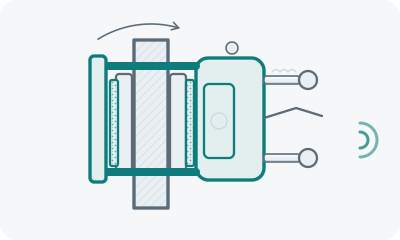
A floating caliper is a simple thing: the carrier with the piston slides on two steel pins, so it can centre itself and press both pads evenly against the disc. While the pins move freely, the brake works as designed. But boots tear, grease ages and washes out, water and road salt get into the clearance — and a slide pin seizes. Then the characteristic set of symptoms begins, which drivers usually describe as “the car does not roll as well and pulls to one side”.
What happens when a pin seizes
When a pin stops moving, the carrier loses its freedom. The piston still presses the inner pad, while the outer one either barely takes part in braking or, conversely, cannot come away from the disc after you release the pedal. Either way the mechanism stops fully releasing: a pad stays pressed and rubs on the disc constantly.
Constant friction generates heat. The disc and the hub get hot, the heated brake fluid in the circuit expands, the brake binds harder — a vicious circle that in bad cases ends with a disc heated blue and boiling fluid with a sinking pedal.
What the driver notices
- One hot wheel. After a calm drive the disc on the problem side is noticeably hotter than the others, sometimes with a burning smell.
- The car does not roll as well. In neutral it slows itself, fuel consumption rises and the engine works harder on climbs.
- Pulling under braking. The steering pulls towards the side where the brake works harder.
- Grinding and roaring from the problem wheel: the overheated pad wears down to the backing and starts cutting the disc. That stage is covered on the symptom page grinding when braking and in telling brake pad wear by ear.
- Uneven wear. The inner pad almost gone, the outer one like new — or the reverse.
- Judder and pedal vibration after the disc has overheated.
What it can be confused with
| Sign | Seized slide pins | Another source |
|---|---|---|
| Grinding strictly when the pedal is pressed | Yes, at a late stage | Worn pads on both sides |
| Crunching and clicking in a tight turn under power | No | A worn outer CV joint |
| A hum that grows with speed | No | Wheel bearing |
| Chattering and whining from under the bonnet | No | A/C compressor clutch |
| A wheel hot after calm driving | Characteristic | A seized piston, a rusted handbrake cable at the rear |
Two similar faults are worth separating: seized slide pins and a seized piston in the caliper bore. The symptoms are close, but with seized pins the uneven pad wear is more pronounced, while with a seized piston the pads wear more evenly and the pedal goes wooden while the wheel heats up more. The exact diagnosis comes with the wheel off: the mechanic frees the mechanism, checks the carrier’s travel by hand and pushes the piston back with a tool. The full set of driver-level checks is in how to check a brake caliper for sticking.
How the repair is decided
The standard procedure is a caliper service: the mechanism comes off, the pins are removed, cleaned of corrosion, new boots are fitted and a special grease is packed in — one that withstands high temperature and does not attack rubber. Ordinary chassis grease is not suitable: it is squeezed out and destroys the boots. If the pins are pitted, they are replaced.
Two questions worth asking. Whether the pins are being stripped and regreased or merely “looked at” — dry pins are the single most common reason the fault returns a month later. And whether the disc was measured against its minimum thickness after overheating, because a disc that has been cooked and skimmed below the limit has to be replaced rather than reused.
It makes sense to service both sides of an axle at once: they live in the same conditions and the second caliper is usually not far behind the first. A sensible preventive interval is to look into the slide pins at every pad change: it adds a little time but renews the boots and the grease before water gets in. Where winter salt and spring slush are part of life, that habit pays for itself fastest — pin corrosion starts with a damaged boot, not with mileage.
If the car feels like it is not rolling freely and you hear a sound from one wheel, record it in the Pro-Stuk app while coasting and under light braking. The app matches the recording with your answers about heat and pulling and suggests what to have checked first — the brake mechanism or the running gear.
