

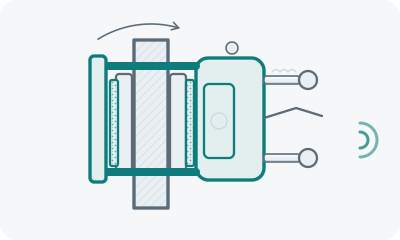
A sticking caliper is one of those faults that lives unnoticed for a long time and then suddenly turns into an overheated disc, ruined pads and extra fuel consumption. The cause is almost always mechanical: the slide pins seize or the piston binds in its bore, and the pad stops coming away from the disc. You can check for it yourself, without a lift, if you know what to watch.
Four tests you can do yourself
The coasting test. On a level, empty area, accelerate to 30–40 km/h and select neutral. The car should roll for a long time and evenly. If it slows itself, as though someone were holding the pedal, and the deceleration is noticeably stronger than usual, there is constant friction.
The temperature check. Drive 10–15 kilometres calmly, braking as little as possible, and immediately after stopping bring a hand near each disc without touching it. The difference between wheels on one axle is the main marker. One wheel noticeably hotter than the rest, with a smell of hot metal coming off it, puts that caliper under suspicion.
The pulling test. On an empty straight, brake gently and loosen your grip on the wheel. If the car consistently pulls to one side, braking forces are unequal.
Pad inspection. Through the wheel spokes you can see the thickness of the outer pad. If it is worn almost to nothing on one side while the other still has half its material, the pad is permanently pressed and the piston or slide pins are not releasing.
What each picture means
| Symptom | Most likely cause |
|---|---|
| One disc hot, the car pulls | Seized piston or slide pins |
| Both discs on an axle hot | The master cylinder or hoses not releasing |
| Pads worn unevenly | Seized slide pins |
| Grinding when braking | Pads finished, metal on metal |
| A hum that ignores the brake pedal | More likely a wheel bearing than the brakes |
That last row matters: a hum is often blamed on the brakes although the source rotates with the wheel. A simple rule separates them — bearing noise does not react to the brake pedal, while pad grinding appears exactly when you press it. The catalogue of braking sounds is on the symptom page grinding when braking, and finding the side and axle is covered in working out where a hum comes from.
What a workshop checks
On a lift the diagnosis takes minutes. The mechanic raises the wheel and spins it by hand: the disc should turn freely, with a light touch of the pads rather than resistance. Then the caliper comes off, the slide pins are checked — they should move by hand — and the boots inspected. The piston is pushed back with a tool: if it moves stiffly or not at all, the bore has seized.
The brake hoses get looked at separately. Rubber ages from the inside and starts acting as a one-way valve: fluid passes under pressure but does not return. Such a hose looks intact from outside while the wheel stays partly braked after you release the pedal.
The condition of the brake fluid is checked too. It is hygroscopic — it absorbs moisture from the air over time, and with moisture comes corrosion inside the cylinders. That is exactly why regular fluid changes indirectly extend caliper life, and why skipping them for years so often ends in a seized piston.
How the repair is decided
The first fork is service or replace. A caliper whose bore is sound is stripped, cleaned and rebuilt with new boots, grease and seals; one with a corroded bore is replaced, because new seals in a pitted cylinder fail again within months. Ask which of the two your caliper is and why — the answer should refer to the state of the bore, not to convenience.
The second is what else is included. If the caliper has been sticking, the disc and pads on that side have almost certainly suffered, and the disc has a minimum thickness stamped on it that decides whether it can stay. A quote for a caliper alone, with no word about the disc, is worth questioning.
Do not postpone. An overheated disc distorts, the pad burns away, and the wheel bearing and seal suffer as heat travels into the hub. A rebuild costs less than replacing disc, pads and caliper together later.
If a new noise appeared alongside all this and you want to capture it before the visit, start a recording in the Pro-Stuk app and drive a test lap. The app matches the sound with your answers about the conditions and shows the likely causes with percentages — and the recording stays with the mechanic instead of a verbal description.
