

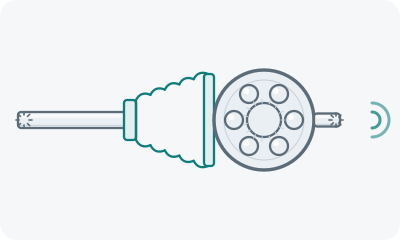
On front-wheel-drive cars the driveshafts carry torque to the wheels while CV joints — constant velocity joints — let those wheels steer. The outer joint sits right at the wheel and works at the largest angles, so of all the driveshaft joints it is the first to give up. Fortunately it dies loudly and predictably: it almost always warns you with sound first. Below are all the signs of wear, the checks you can do without a lift, and what actually decides the repair.
How the outer joint works and why it wears
Inside the joint six balls are held by a cage between grooves in the outer housing and the inner race. That layout transmits torque smoothly at any steering angle. The whole unit is packed with heavy grease and closed by a pleated boot of rubber or thermoplastic.
While the boot is intact, the outer CV joint is one of the most durable parts on the car. But the rubber ages, cracks in the cold, is cut by gravel — and the grease is squeezed out while water and sand get in. The abrasive quickly eats the grooves and the balls, clearances appear in the joint, and the clicking begins. Most outer CV joint replacements are the direct result of an unnoticed torn boot, not of metal fatigue.
The main sign: clicking in a turn
The sound of a worn outer joint is dry, ringing clicks or rattling whose frequency rises with speed. The typical scenarios where it is first heard:
- pulling out of a parking space with the wheel at full lock;
- accelerating through a turn at a junction;
- entering a car park or making a U-turn under power.
Note the pattern: the sound needs an angle (wheel turned), load (throttle applied) and motion at the same time. Coasting through the same turn, a worn joint is usually silent.
The direction of the turn hints at the side: workshops more often find the joint on the outside of the turn is the one clicking — turning right, the left one; turning left, the right one — because the weight transfers to it and it turns faster. The rule is not absolute, so confirm the side by inspecting the boots and testing. The symptom itself is covered on clicking when steering.
The signs by stage
| Stage | What you hear and see | What to do |
|---|---|---|
| Boot torn, no wear | No sound; grease flung over the wheel and arm | Replace the boot with fresh grease at once — the joint is still alive |
| Early wear | Single clicks pulling away at full lock | Inspect the boot, plan the replacement |
| Marked wear | Series of clicks in every turn under power | Replace within weeks |
| Deep wear | Rattling with the wheels almost straight, vibration under acceleration, play | Risky to drive, replace without delay |
How fast the stages follow one another depends above all on the state of the boot — with a torn one the process runs many times faster, as set out in a torn CV boot: how far can you drive.
Outer or inner: telling them apart
The inner joint sits by the gearbox and works at small angles, so it wears noticeably less often. Their symptoms differ:
- outer — clicking and rattling in turns under load;
- inner — vibration and jolts accelerating in a straight line, often in a narrow speed band, sometimes a hum or a tug as you swap between throttle and brake.
There are lookalikes from the running gear too. An even, growing hum in a turn is the signature of a wheel bearing rather than a CV joint: it has no clicks and it follows which side is loaded, as covered on humming when turning. If the hum is constant and stays in a straight line, rule out the tyres first — humming: wheel bearing or tyres.
How to check without a lift
- Inspect the boots. Turn the wheel to full lock in one direction — that wheel’s outer boot opens up for inspection. Look for cracks in the folds, tears, and grease on the wheel, the arm and the inner side of the wing.
- The circle test. On an empty area, turn to full lock and drive a circle with light acceleration, then the other way. A worn joint answers with a series of clicks — the full method is in checking a CV joint by driving circles.
- Reverse at full lock. An arc backwards with the wheel fully turned loads the joint at its maximum angle — a tired CV joint often clicks here before it does in ordinary turns.
- Check for play. With the wheel jacked up, take the driveshaft next to the joint and turn it both ways. Perceptible free movement with a metallic knock means wear.
Inspecting the boots is easiest to combine with a seasonal wheel change: the car is already up and four boots take a couple of minutes. On four-wheel-drive and rear-wheel-drive cars with independent suspension there are CV joints in the rear driveshafts too, so clicking from the back in turns is checked with the same circle test.
How the repair is decided
If the clicking is already regular, replacing only the boot is pointless — the joint is worn. Before that stage, a boot with a proper strip, wash and repack is a fraction of the cost, and the whole difference comes down to how early it was spotted.
On older cars a complete driveshaft is sometimes the better buy: dearer as a part, but quicker to fit and it brings a new inner joint with it. Ask which you are being quoted and why. There is no need to replace joints in pairs the way dampers are done — only the worn one; with an intact boot the other side can run for years.
Two things worth confirming: that the correct molybdenum CV grease is being used, and that the boot clamps are the proper crimped type rather than cable ties. Both are small details that decide whether the repair lasts.
Not sure it is the CV joint clicking? Record the sound in the Pro-Stuk app during a slow circle at full lock — the app matches the recording with your answers and shows the likely causes with percentages and an urgency level. With that result it is easier to plan the workshop visit.
