

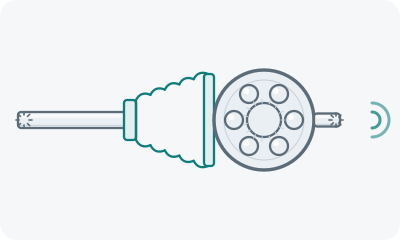
The rubber or plastic boot on a driveshaft looks like a trivial part, and that is exactly why a tear in it gets left “until the next service”. In reality the boot is not decoration but the only thing keeping grease inside the joint and water and sand outside. From the moment it tears a countdown starts, and the question “how much further can I drive” has not one answer but a range from a couple of hundred kilometres to several thousand. Here is what that range depends on.
What happens after the tear
A CV joint — a constant velocity joint — transmits rotation to the wheel while letting it steer and move up and down. Inside are balls and raceways working in a special heavy grease. While the boot is intact that grease lasts the life of the unit.
The moment the rubber splits, two things happen at once. First, centrifugal force throws the grease out — the characteristic dark splatter on the wheel arch, the wheel and the control arm is exactly that. Second, and far more destructive, road dust, sand and water fly in through the same tear. Sand in grease works like grinding paste: within a few thousand kilometres it grinds grooves into the raceways, the balls lose their support, play appears — and the joint starts clicking in turns.
What the remaining margin depends on
| Factor | Extends the life | Shortens the life |
|---|---|---|
| How fresh the tear is | Found at once, grease still in | Driven for months, boot empty |
| Size of the tear | A crack by the clamp | The boot split all the way round |
| Weather and roads | Dry tarmac, summer | Slush, mud, gravel |
| Driving style | Gentle turns, town | Sharp starts at full lock |
| Which joint | Inner, smaller angles | Outer, higher angles and load |
Add up the favourable options and a torn boot will comfortably last until a booked visit a week or two away. Add up the unfavourable ones and clicking can appear within a few hundred kilometres of wet gravel. That is exactly why mechanics answer evasively: without inspecting the joint no honest figure can be named.
How to tell whether the joint has already suffered
The main marker is sound. While the joint stays silent in every regime there is a chance of getting away with a rebuild. The outer joint usually speaks first: a dry rattling crunch when turning under power, most often when pulling away at full lock. The sound portrait is on the symptom page clicking when steering, and the confirmation test is in checking a CV joint by driving circles. The inner joint behaves differently: it gives itself away with a click or a jolt as the car starts moving, especially in reverse.
The second marker is play. On a lift the shaft is taken in both hands and twisted against the hub: noticeable free movement means the tracks are already worn. The third is the state of the grease itself: grey, with sand gritty between your fingers instead of an even heavy paste, speaks for itself.
How the repair is decided
The arithmetic is simple: a rebuild with a new boot costs a fraction of replacing the joint, and the whole difference comes down to how quickly the tear was spotted.
Two things are worth asking. First, whether the joint will actually be stripped and washed, or a new boot simply pulled over the old grease — packing a fresh boot around sand-laden grease is the reason a “repaired” joint starts clicking a month later. Second, what grease is going in: CV joints use a specific molybdenum-based grease, and the wrong one shortens the life of an otherwise good repair.
There is also a choice between the joint alone and the complete driveshaft. If the splines and the shaft are sound, the joint is enough and the part is cheaper; on a high-mileage car that already vibrates, the whole shaft avoids a repeat visit. The decision is made with the shaft off, so the final figure is named during the job.
The practical conclusion: if you see dark splatter on the wheel arch, do not wait for clicking — book an inspection within days. What happens once the clicking has started is set out in can you drive with a clicking CV joint.
And if the sound has already appeared and you want to know whether it is the outer joint or something else, record it in the Pro-Stuk app while pulling away at full lock: the app matches the recording with your answers to a few questions and shows the likely causes with percentages.
