

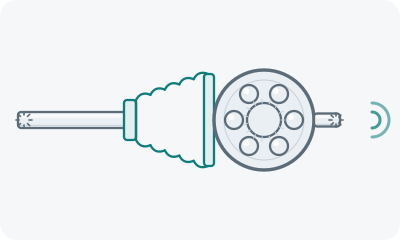
Clicking as you turn the wheel under power is a sound almost every long-standing owner of a front-wheel-drive car has heard. The question is usually not “what is it” but “how much longer can I drive like this”. The honest answer: for a while you can, but that margin is not measured in years and it depends on the stage the joint has reached. Here is how to judge the stage yourself and where the line is beyond which you should not drive.
What happens inside the joint
A CV joint — a constant velocity joint — transmits torque from the gearbox to the wheel through a changing angle. Inside are balls in cages, packed with special grease and sealed by a rubber boot. While the boot is intact the unit lasts a very long time: the grease stays in, sand and water stay out.
Practically all CV joint wear starts with a crack in the boot. Centrifugal force gradually throws the grease out, abrasive gets in, the cage tracks wear, play appears — and at large steering angles under load the balls start skipping over the worn tracks. That is the clicking.
Three stages and the time each leaves you
| Stage | Signs | How much time |
|---|---|---|
| Early | Barely audible clicking only at full lock under power | Weeks, planned repair |
| Middle | Clear clicking in any tight turn, starts clicking in reverse | Days to weeks, book the workshop |
| Late | Knocking in a straight line, vibration, jerking when pulling away | Do not drive except to the workshop |
The difference between the stages is not loudness in itself but which regimes produce the sound. While the clicking only lives at large angles under load, the joint is still coping with straight-line driving. As soon as the sound appears in a straight line and vibration joins it, the wear has reached the point where failure is a matter of the near future. The inner joint, incidentally, knocks differently — not in a turn but under acceleration.
How to drive while you wait for the repair
If you have decided to drive there yourself, it makes sense to reduce the load on the worn joint:
- Do not turn the wheel to full lock under power. That combination loads the cages the most. On a car park, manoeuvre in short movements.
- Pull away gently. A sharp start puts a shock load through the whole driveshaft.
- Avoid the motorway. At high speed a worn joint gets hotter and breaks up faster.
- Do not spin the wheels. Wheelspin in snow or mud with the wheels turned is the fastest way to finish a CV joint off.
It is also worth making sure the source has been identified correctly. Clicking in a turn does not come only from joints: strut top mounts and steering components sound similar. The catalogue of such sounds and how to separate them is on the symptom page clicking when steering, and the confirmation test is in checking a CV joint by driving circles.
How the repair is decided
The first fork is the joint or the whole driveshaft. If the splines and the shaft are sound, the joint alone is enough and the part is cheaper. If the mileage is high and the shaft already vibrates, workshops often suggest the complete assembly — the labour is the same and there is no repeat visit six months later. The decision is made once the shaft is off and inspected, so the final figure is named during the job, not before it.
The second is whether a boot alone will do. While there is no clicking, a new boot with the joint cleaned and repacked with fresh grease is a fraction of the cost of a new joint — which is exactly why the boots are worth checking at every service. Once clicking has started, a new boot only seals in a joint that is already worn, and the noise comes back.
The third is a question worth asking outright: what grease is going in. CV joints use a specific molybdenum-based grease, and the wrong one shortens the life of an otherwise good repair.
If the clicking is barely audible and it is hard to tell whether the stage is early or middle, record the sound in the Pro-Stuk app during a slow circle at full lock. The app matches the recording with your answers to a few questions and shows how much the situation can wait and whether a tow truck should be planned.
