

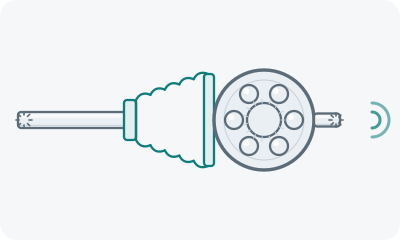
Everyone knows the outer CV joint: it starts crunching in turns, so it gets replaced. The inner joint on the same driveshaft is far less known, though it fails just as often. The problem is that it sounds completely different and so regularly collects somebody else’s diagnosis: its symptoms are blamed on the suspension, the engine mounts or unbalanced wheels. Here is how it actually behaves.
Where it sits and why it sounds different
A front driveshaft has two joints. The outer one, at the hub, works at large steering angles: its job is to turn a wheel that follows the steering. The inner one, at the gearbox, barely handles angles at all but compensates for suspension travel and for the change in shaft length as the suspension compresses and extends — in design it is usually a tripod, three rollers on trunnions sliding in the housing’s tracks.
Hence the difference in symptoms. The outer joint is loaded by steering, so it rattles in a manoeuvre. The inner one is loaded by drive and suspension travel, so it speaks up under acceleration and over bumps, while the steering barely affects it.
What the wear sounds like
| Sign | When it appears |
|---|---|
| A dull knock when pulling away | The first throttle after a stop |
| A knock accelerating over bumps | Potholes and undulations under power |
| Vibration in the body and floor | Accelerating and climbing, grows under load |
| A click on selecting reverse | The load direction changes in the joint |
| Crunching in a turn | That is the outer joint, not the inner one |
| A knock over bumps with no throttle | More likely the suspension than the driveshaft |
The last two rows are the typical false trails. If the knock is heard over bumps while coasting with no drive, the driveshaft is probably not involved. The general catalogue of sounds tied specifically to drive is on the symptom page knocking when accelerating, and play in the shaft’s splines has its own breakdown in signs of worn driveshaft splines.
Checking it yourself
The inspection takes a few minutes and needs no lift, though one helps:
- The boot. Find the inner joint at the gearbox and inspect the rubber cover. A tear, cracks, grease over the subframe and splatter on the body nearby are practically a verdict.
- The acceleration test. On a level stretch accelerate from 20 to 60 km/h with normal throttle, then lift off. A knock and vibration only under drive point at the driveshaft.
- The reverse test. Move off slowly backwards, then forwards. A single click as the direction changes means play in the joint or the splines.
- Play by hand. With the wheel raised, rock the shaft at the gearbox along and across its axis: noticeable free movement confirms wear.
How fast the problem develops is almost entirely decided by the boot: while it is intact the joint covers hundreds of thousands of kilometres; after it tears the count is in weeks. That scenario is set out in a torn CV boot: how far can you drive, and the outer joint’s own signs in signs of a worn outer CV joint.
How the repair is decided and how urgent it is
The first question is the joint or the complete shaft. On a high-mileage car with worn splines the whole shaft avoids a repeat visit; on a sound shaft the joint alone is cheaper. The decision is made with the shaft off.
The second is the grease and the boot clamps — CV joints need their specific molybdenum grease and properly crimped clamps, and both are small details that decide whether the repair lasts.
The third is worth asking outright: whether the inner joint’s housing was inspected for scoring in its tracks, not just the rollers. A tripod replaced into a scored housing starts vibrating again within months.
On urgency the inner joint behaves more gently than the outer one: it rarely fails suddenly, more often knocking and vibrating for a long time. But driveshaft vibration wears its neighbours — engine mounts, the gearbox bearing — and a drawn-out wait turns one line on the bill into three. Once it starts clicking, the guidance in can you drive with a clicking CV joint applies.
If the knock is faint and it is unclear whether it is the driveshaft or the suspension, record it in the Pro-Stuk app twice: under throttle and coasting on the same stretch of road. The app compares the recordings, takes your answers about when exactly the sound appears into account and shows the likely causes with percentages.
