

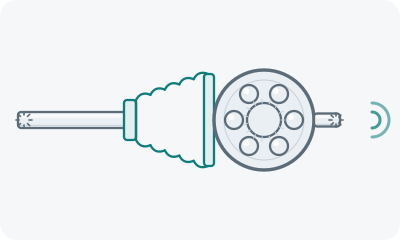
The first clicks from a CV joint — the constant velocity joint that carries torque to a steering wheel — are neither a verdict nor a reason to abandon the car at the roadside. But nor should they be ignored for months. The honest answer to “how much further will I get” is: from a few hundred to tens of thousands of kilometres, and that whole spread is decided by one thing — the state of the boot. Below are the guides by stage, the factors that accelerate the failure, and the real risks.
Why there is no exact figure
A clicking CV joint has two fundamentally different scripts:
- The boot is intact, the wear is natural. The grease is in place, there is no abrasive inside. The tracks wear slowly, and from the first single clicks to the need for replacement usually takes thousands, even tens of thousands, of kilometres.
- The boot is torn. The grease has been thrown out and there is water and sand inside. The joint works like a grindstone and is destroyed in thousands, or with hard use hundreds, of kilometres. In winter slush the process is faster still.
So the first action after the first clicks is not counting the remaining life but inspecting the boot: turn the steering to full lock and shine a torch into the pleats. An intact boot with no grease outside means there is time. A split with grease flung about means the count is in weeks — the detail is in a torn CV boot: how far can you drive.
A third factor is how the car is used. The same joint in calm town driving and in daily full-lock launches over broken yards wears at different rates, so someone else’s “I drove for a year with the clicking” transfers poorly to your car.
Guidance by stage
The table below is the typical picture, not a guarantee: a particular joint can degrade faster, especially without grease.
| Stage | Sound | Typical margin left |
|---|---|---|
| First clicks | Single, only pulling away at full lock | Thousands of km with an intact boot |
| Regular rattling | Series of clicks in every turn under power | Hundreds to a few thousand km |
| Rattling in a straight line | Audible accelerating with barely any steering, vibration appears | Tens to hundreds of km, risky to drive |
| Play and thumps | Knocking on throttle/brake changes, vibration at any speed | Life used up, replace immediately |
How to recognise each stage by ear, and how to avoid confusing the outer joint with the inner one, is set out in signs of a worn outer CV joint and on the symptom page clicking when steering. A useful marker of the trend: if a week or two separated “occasional clicks” from “rattling in every turn”, the boot is almost certainly torn and there is no time to wait.
What accelerates the failure
- A torn or cracked boot — factor number one, accelerating the wear tenfold.
- Water and dirt: deep puddles, fords, winter slush — all of it gets inside through the smallest crack in the pleats.
- Sharp launches at full lock and wheelspin: maximum angle plus maximum torque is the hardest regime for an outer CV joint.
- Broken roads: suspension impacts pass into the joint and batter already damaged tracks.
- Towing and overloading — more torque transmitted in every regime.
Remove from that list what is under your control and a clicking joint will last noticeably longer.
What the driver risks
It is useful to compare with another noisy component — the wheel bearing. A bearing is dangerous because at its extreme stage it can skew or even seize the wheel, so stretching it out is riskier — see can you drive with a humming wheel bearing. A CV joint fails differently: it rarely seizes, more often loosening gradually and finally breaking up — the cage disintegrates, the balls fall out, and torque stops being transmitted. The car simply stops moving.
The main risks look like this:
- being immobilised in an awkward place — a motorway, a junction, a level crossing, with all the towing costs that follow;
- failing under load mid-manoeuvre — losing drive while overtaking or pulling onto a main road;
- collateral damage — fragments and a flailing shaft can catch boots, ABS sensors and neighbouring parts.
A separate trap is blaming the CV joint for someone else’s sound. An even hum that grows in a turn is a bearing’s signature, not a joint’s: check against the symptom page humming when turning and signs of a worn wheel bearing before ordering parts.
Getting to the replacement without drama
- Drive gently: do not launch at full lock, do not spin the wheels, do not take corners with the throttle buried.
- Inspect the boot at once. If it tore recently and there is no clicking yet, or only the occasional click, a new boot with fresh grease can stop the process — cheaper than a new joint.
- Track the trend: note how often and in which regimes the clicks appear. A sharp increase means going to a workshop rather than waiting for next week’s booking.
- Do not plan long motorway trips: a joint that fails far from home turns an inexpensive repair into expensive logistics.
How the replacement is decided
The economics are simple: replacing at the first-clicks stage means one joint and boots. Replacing after a failure usually means a complete shaft, a tow truck and unplanned downtime. There is no need to replace joints in pairs: if the other boot is intact and there are no sounds, it needs no attention.
Two things worth confirming with the workshop: that the correct molybdenum CV grease is used, and that the boot clamps are the proper crimped type. Both are small details that decide whether the repair lasts years or months.
If you want to know which stage your joint is at, record the sound in the Pro-Stuk app during a slow circle at full lock. The app matches the recording with your answers to a few questions and shows the likely causes with an urgency level — which makes it easier to decide between going in tomorrow and calmly picking a day this week.
