

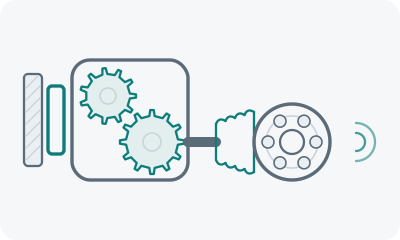
The car is parked, reverse is selected, the brake is released — and in the first second of movement one dry click comes from below. Then silence, the car drives normally, and nothing similar is heard going forward. The sound is unsettling in its suddenness, but by its nature it almost always means the same thing: somewhere in the chain from engine to wheel there is a clearance, and when the direction of rotation changes the part shifts from one bearing face to the other. The only question is which part, and how big the clearance has grown.
Why specifically in reverse
While the car drives forward, every part with play is pressed by the load to one side: the splines bear on one flank, the pad sits at one edge of its guide, the joint is loaded in one direction. Change direction and each of those pairs jumps its clearance to the opposite stop. The individual micro-jumps merge into one audible click.
So reverse works as free diagnosis: it highlights clearances that ordinary forward driving never reveals. A click appearing does not mean a breakdown, but it does mean the play has grown to an audible size — and from there it only increases.
Who clicks most often
| Source | Additional signs |
|---|---|
| Pad in the caliper | A click at the first braking after moving off, sound at the wheel |
| Outer CV joint | Crunching appears in a turn under power, grease traces |
| Inner CV joint | A thump through the body when pulling away, vibration under acceleration |
| Propshaft universal joint | Click under the centre of the floor, vibration at speed |
| Engine mount | The engine visibly nods when shifting from D to R |
| Anti-roll bar link | The click repeats over bumps, not only when starting |
Location is a convenient guide. A click at a front wheel with grease on the arch is the driveshaft joints, covered in detail in signs of a worn outer CV joint and, for the inner one, in signs of a worn inner CV joint. A click from under the centre of the floor on a rear- or four-wheel-drive car is the propshaft, where the joint gives up first: signs of a worn propshaft universal joint. The general catalogue of sounds from below is on the symptom page rattling under the car, and the brake version in a single clunk when pulling away and braking.
Narrowing it down in five minutes
The checks need no lift and are done on an empty area.
- The repeat test. Drive forward a metre, stop, select reverse and pull away. If the click repeats reliably at every change of direction, it is play rather than chance.
- The brake test. Pull away in reverse without touching the brake, then brake gently. If the click appears specifically at the first press of the pedal, suspicion moves to the pads in the caliper.
- The neutral test. Roll backwards in neutral down a slope. If the click has gone, the source is in the drive path; if it remains, in the running gear or the brakes.
- The steering test. Repeat the reverse start with the steering at full lock. A crunch that grows is almost certainly the outer driveshaft joint.
What to do about it
A single click with no vibration and no other noises on the move is a reason to have the car looked at during the next scheduled service, not to drop everything. A different picture calls for a prompt visit: the click comes with a thump through the body, vibration has appeared at speed, or crunching has started under load.
The spread in cost is wide, and the figure depends directly on how early the source is found — an engine mount is an inexpensive part, while letting a driveshaft joint go until the splines are damaged is not, as covered in signs of worn engine mounts.
Two things are worth asking for at the inspection. That the mechanic reproduces the click with the car on the ground rather than only looking for play on a raised wheel — some clearances only show under load. And that the brake side is ruled out first, because it is the cheapest and most common answer.
If you want to narrow the list before the workshop visit, record the sound in the Pro-Stuk app during a reverse start: the app matches the recording with your answers to a few questions and shows the likely causes with percentages.
