

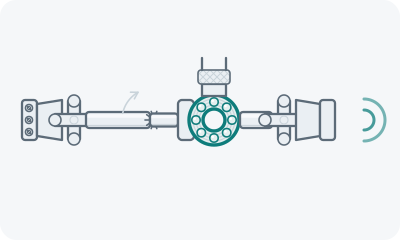
A universal joint is the propshaft’s hinge, transmitting rotation from the gearbox to the rear differential while letting the shaft flex as the suspension works over bumps. Inside its four trunnions sit needle bearings, packed with grease and closed by seals. The service life is decent but finite: over time the grease washes out, the needles wear the trunnions, and play appears. And almost always the sound comes first and the vibration second. Here are the signs by stage, so you know where your car is.
Stage one: a clunk as the load changes
The earliest sign is a short metallic click or dull thump under the floor at the moment torque changes direction: pulling away, lifting off sharply, selecting reverse. The play is taken up and the trunnion strikes its cup.
A characteristic detail: the sound comes not from a wheel but from under the centre of the car, roughly from the front seat area or a little further back. It is a single dry event and does not repeat while driving at a steady speed.
Stage two: vibration at speed
As the play grows, the shaft loses its balance. Vibration appears from a certain speed — often somewhere around 80–100 km/h — and grows beyond it. It comes through the floor and the gear lever rather than the steering wheel: an important divider from wheel problems.
| Sign | Universal joint | Wheel imbalance | Centre bearing |
|---|---|---|---|
| Where it is felt | Floor, gear lever | Steering wheel | Floor, centrally |
| Speed dependence | Grows above 80 km/h | Peaks in a narrow band | Hum within a band |
| Reaction to throttle | Changes under load | None | Weak |
| Sound | Clicks, thumps | Silent | An even hum |
| After wheel balancing | Unchanged | Goes away | Unchanged |
If the vibration comes with an even hum, the neighbouring components are worth checking; a rattle from underneath at speed has its own breakdown in rattling under the floor at speed, and separating driveline hum from a wheel bearing is covered in humming: gearbox or wheel bearing.
Stage three: rumbling, grinding and danger
Destroyed needles turn the joint into a source of constant grinding and crunching, audible at any speed. Sometimes a squeak at low speed joins in — a dry trunnion rubbing in its cup without grease. The vibration at this stage becomes a shake the passengers feel.
This is the stage where nothing can be postponed. A ruined joint fails quickly, and a propshaft that tears loose on the move can damage the floor, the fuel line and the brake pipes. The catalogue of such sounds from underneath is on the symptom page rattling under the car.
How to check it
The simple check is done on a lift or over a pit with the engine off and the gearbox in neutral: take the shaft in both hands next to the joint and try to twist and rock it. A healthy joint gives no perceptible free movement. An audible click or noticeable play is a verdict. Also look for traces of rusty dust around the trunnions: a sure sign of a bearing that has run dry.
How the repair is decided
The first question is whether the joint is serviceable on your shaft. If it is, the joint alone is the cheapest route; if the shaft is a sealed assembly, ask whether converting it is genuinely appropriate for your car before agreeing.
The second is what else is checked while the shaft is off. Ask the mechanic to look at both universal joints and the centre bearing at once: dropping a shaft for one joint and coming back a month later for its neighbour is a painful waste of money.
The third is balancing. Longer shafts are balanced after a joint is replaced, and not every workshop offers it. On a two-piece shaft that step is the difference between a repair that removes the vibration and one that merely removes the clunk. Ask whether the shaft will be marked before disassembly so the flanges go back in the same orientation — that alone prevents most post-repair vibration.
If the knock is still occasional and you want to know whether it really comes from under the floor rather than from the suspension, record it in the Pro-Stuk app at the moment of pulling away. The app matches the recording with your answers to a few questions and shows the likely causes with percentages.
