

The situation is familiar to almost everyone: the key is turned, and instead of the usual cranking there is a click or a rapid chatter — then silence. The good news is that the character of the click already narrows the suspects. From the number of clicks, the behaviour of the instrument panel and the brightness of the headlights you can work out with high probability what has happened before you call anyone.
What is actually clicking
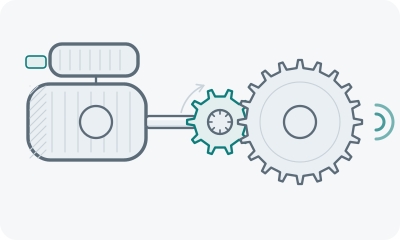
Turning the engine is the starter’s job — an electric motor with a solenoid. When you turn the key the solenoid receives a control signal, pulls its plunger in and does two things at once: it pushes the pinion into mesh with the flywheel ring gear and closes the heavy contacts, feeding the motor hundreds of amps.
The click you hear is the solenoid operating. So the control circuit is healthy: the ignition switch, the relay, the wiring to the starter. What was missing came after that — current, a contact, or the motor itself.
Reading the sound
| What you hear | What is happening | The most likely cause |
|---|---|---|
| Rapid chatter | The solenoid cycling on a voltage sag | A flat or tired battery, corroded terminals |
| One loud click, the panel steady | The solenoid pulled in, no current flowed | Burnt heavy contacts, worn brushes |
| A click and a light grinding | The pinion touched the ring gear but did not turn it | A jammed pinion drive, a damaged ring gear |
| The starter turns but barely | Not quite enough current | A weak battery, a poor earth, worn bushes |
| Complete silence, no click | The control circuit did not reach the solenoid | Ignition switch, relay, selector position switch, immobiliser |
The first thing to do is watch the instrument panel and the headlights as you turn the key. If the lights dim noticeably and the panel goes out, the problem is almost certainly the supply: a flat battery, corroded terminals, a poor earth to the body. If the instruments stay as though nothing has happened and a lone click answers, the cause is more often inside the starter.
A quick check on the spot is to rock the terminals by hand with the engine off: movement and white deposits on the posts speak for themselves. It is also worth switching the main beam on and watching what it does during a start attempt.
What a workshop does
The diagnosis goes from simple to complex: measuring battery voltage before and during a start attempt, a load test, inspecting and tightening the heavy cables and the earth, and only then removing the starter. On the bench the brushes, bushes, commutator and the solenoid’s contact discs are checked. Very often the repair comes down to new contacts and brushes rather than a whole new unit — which is the question worth asking before agreeing to a replacement.
A separate category is when the starter receives no command at all. There the fault is hunted in the ignition switch, the relay, the selector position switch on automatics, the clutch pedal switch on manuals, or the immobiliser. That is electrics, and a scan tool is usually needed.
What not to do
Do not crank in long attempts: a starter is designed for a few seconds at a time and overheats when spun continuously. Leave at least half a minute between attempts. Do not tow a car with an automatic gearbox to bump-start it — on many transmissions that ends in an expensive repair. And do not rush to replace the battery before checking the terminals and the earth: a corroded contact gives exactly the same picture as a dead battery.
While you are at it, note the other sounds when the key is turned: a short buzz from under the rear seats is the fuel pump working normally, covered in fuel pump whine: normal or failing, and chattering from under the bonnet after starting can come from the A/C compressor clutch. Other under-bonnet sounds at start-up are collected on the symptom page squeal on startup.
If the clicking comes and goes and the car treacherously starts first time at the workshop, record a start attempt in the Pro-Stuk app. The app matches the character of the clicks with your answers about how the instruments behaved and suggests what to show the mechanic — the battery, the wiring or the starter.
