

A knock felt through the sole of your foot as well as heard is more unsettling than most car sounds: the brakes are the last system in which you want to hear something new. Yet feedback through the pedal by no means always signals a fault. It has three fundamentally different sources: normal anti-lock braking, play inside the brake mechanism, and running gear wear that simply shows itself under braking load. They are told apart by when the sound appears.
The three sources
The first is the ABS. Under hard braking or on ice the system starts cycling the pressure in the circuit, and the pedal pulses underfoot with a chatter like a ratchet. That is normal, and it does not happen during calm town braking.
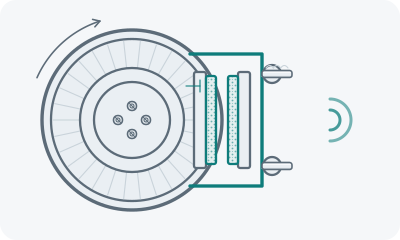
The second is play inside the brake mechanism. The pad sits in its guides with a small clearance. When the retaining shims are worn and the seats are hammered out, the pad moves a millimetre at the first contact with the disc and strikes its stop. Hence a single click at the start of braking and a second as the pedal is released — the detail is in a knock when braking: pads or caliper.
The third is the suspension and steering. Under braking the weight transfers forward, the ball joints, control arm bushes and track rod ends are loaded differently, and a worn part knocks at exactly that moment while the brakes are healthy. The general picture of knocks under load is on the symptom page knocking in the suspension.
Identifying your case
| When the knock appears | Likely source |
|---|---|
| Only under emergency braking, the pedal shakes rapidly | ABS at work, normal |
| A single click at the start and end of braking | Pad play in the caliper |
| A knock when braking over bumps | Suspension: links, bushes |
| A knock braking in reverse | Caliper slide pins, pads |
| Rhythmic pulsing, frequency rising with speed | Disc geometry, not a knock |
| A knock with the pedal sinking | Needs an urgent circuit check |
The last row is the only one that cannot be postponed. If the pedal has gone soft, sinks or needs a second press, that is no longer about sound but about pressure, and the sensible move is to stop driving.
The order of checks
- Rule the ABS out. A calm stop from 40 km/h on dry tarmac. If there is no pulsing and the knock was only in hard braking, it was the system.
- The reverse test. Drive back a couple of metres and brake. Pad play in the guides gives a knock with the opposite sign: the pad moves the other way and the click is clearer.
- Separate brakes from suspension. Braking on a level surface and braking on a bump. If the knock appears only along with suspension movement, the brake mechanism is not involved.
- Check the steering. A knock with shaking in the wheel points at the disc and the hub; separating wheel noises is covered in humming: wheel bearing or tyres, and judder itself in brake judder when braking.
- Inspect the mechanism. Take the wheel off and rock the pad by hand: noticeable movement and hammered stops are visible at once.
A separate situation is a knock on a recently serviced car: after new pads some sounds count as normal, and a morning squeal after standing has its own explanation in brake squeal after standing.
Urgency and how the repair is decided
The urgency depends on what is found. Pad play is a matter for the next scheduled visit. A worn ball joint is a matter of a week: that joint holds the wheel in the suspension geometry, and its failure takes the car out of control — signs of a worn ball joint. A sinking pedal is a matter of today.
Two things worth asking at the workshop. That the caliper slide pins are stripped and regreased rather than glanced at — that is what cures most mechanism-side knocks, as covered in signs of seized caliper slide pins. And that the pad fitting kit — shims and springs — goes in with new pads, because it is what stops the pad moving in the first place.
Telling by ear whether a caliper or a control arm is knocking is hard even for an experienced driver: the sound arrives through the body and loses its address. A recording made in the Pro-Stuk app during a series of stops, together with answers to short questions, gives a list of likely causes with percentages.
