

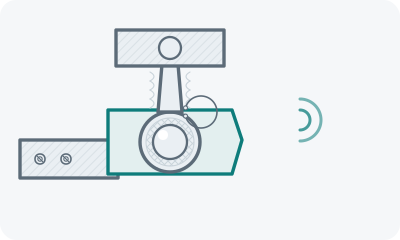
A ball joint is the pivot connecting a suspension arm to the steering knuckle: a steel pin with a ball on the end turning in a housing with a plastic liner and grease. It is this part that lets the wheel steer and move up and down at the same time. Unlike many other suspension components, a worn ball joint is not only noise and discomfort but a real risk: when it fails completely the pin comes out of the housing and the wheel folds under. The good news is that it warns you clearly for a long time before that. Here are the signs in order.
How the wear shows itself
- A metallic knock over small bumps. The most common sign: abrupt, sharper and drier than the rubbery knock of bushes. It appears over joints, gravel and fine washboard; on large potholes it can be less noticeable. The general description is on knocking over bumps.
- A knock when pulling away and braking. The worn joint takes up its play as the load changes — a single “tock” as you start or stop.
- Creaking when the steering is turned. A dried or corroded joint creaks as it rotates, especially while parked and at low speed. A strut top mount bearing sounds similar — the difference is that a ball joint usually creaks over bumps too, not only when steering. The related symptom is clicking when steering.
- Wandering and an unsettled front end. The car follows ruts, the steering feels empty around centre, the front end lives its own life over bumps.
- Uneven tyre wear. With play in the joint the wheel stands at the wrong angle and the tyre is eaten along its inner edge.
The stages of wear
| Stage | Signs | Risk | What to do |
|---|---|---|---|
| Early | Occasional creak, light knock on washboard | Low | Inspect the boot, watch |
| Middle | Regular knock over small bumps, creaking steering | Moderate | Diagnosis within 1–2 weeks |
| Late | Noticeable wheel play, knock on any road, chewing tyres | High | Replace without delay |
| Critical | Heavy play, clattering, the car pulls | Emergency | Do not use until replaced |
The boundaries are approximate and the degradation is non-linear: one hard pothole strike can take a joint from the early stage straight to the late one. With a torn boot the clock runs faster — water and sand work as an abrasive.
How to check it yourself
The quick test without a lift: rock the car by the wing over each front wheel and listen — a knock with a creak below gives the joint away. The more telling check is done with the wheel raised: take it at the top and bottom (12 and 6 o’clock) and rock it. Play with a dull knock points at the ball joint or the wheel bearing; you can separate them by having a helper press the brake — bearing play disappears, ball joint play remains. The step-by-step method with all the caveats is in how to check a ball joint yourself.
It is important not to confuse a ball joint with the bushes — they knock in similar situations, but the rubber-to-metal joints sound duller and the consequences are far less dangerous. Their signs are in signs of worn suspension bushes.
The boot is the main indicator
A ball joint’s life depends almost entirely on the state of its protective boot — the rubber cover that keeps grease inside and water and sand out. While the boot is intact, on many cars the joint covers 100,000–150,000 km and more. A torn boot cuts the remaining life to a few months: the grease washes out and the pin and liner start working dry and with abrasive.
Two practical conclusions follow. First: inspecting the boots at every oil change or seasonal tyre swap is the cheapest prevention there is — it costs nothing and takes a minute while the car is up. Second: if the boot is torn, replacing only the boot is almost always pointless — dirt is already inside, and an honest workshop will suggest replacing the joint. Cracks, grease traces and rust around the boot are reasons to plan the replacement even before a knock appears.
How the repair is decided
The first question is whether the joint is separately replaceable on your car or comes only with the arm — the answer changes the cost several-fold, so ask before comparing quotes. The second is the alignment, which is needed after the job.
Two things workshops do not always volunteer. A pressed-in joint needs the correct press tooling; hammered in, it is damaged from the first kilometre. And the pin’s castellated nut and split pin, where fitted, are single-use items — a nut reused and merely “done up tight” is the reason some joints work loose again within months.
Replacing joints in pairs is not compulsory, but if both are the same age and one is finished, the other is usually close behind — worth checking on the same lift.
What ignoring it leads to
The main risk scenario is the pin pulling out of the housing. The wheel folds under, the car drops onto the arm and instantly loses steering. Most often that happens not on a motorway but in a pothole or on a kerb, when a shock load meets a worn joint — but the moment cannot be predicted. What it means in practice is set out in what a broken ball joint means. Even without a failure, a worn ball joint eats tyres, loosens the steering and adds noise that is easily confused with other suspension problems.
If something knocks below and the source is not obvious, record the sound in the Pro-Stuk app. It matches the recording with your answers about when and how the sound appears and shows the likely causes with an urgency level.
