

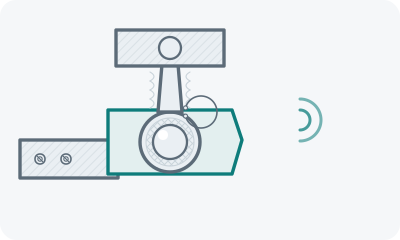
A ball joint is the pivot connecting the suspension arm to the hub carrier: a steel pin with a ball turning inside a housing with grease and a plastic seat. You can check its condition yourself, in a garage or on a level car park: you need a jack, wheel chocks and ten to fifteen minutes. Below are the tests from simple to precise, and a table that turns the results into a decision.
When to check it
The usual reasons: a sharp metallic knock at the front over small bumps — expansion joints, gravel, washboard; a single thud when pulling away and braking; a creak when turning the wheel; the car wandering in ruts. The general description of similar sounds is on the page knocking over bumps.
There is a preventive reason too: any trip under the car — an oil change, a tyre swap — is worth using to look at the ball joint boots. It takes a minute and often catches the problem before the first knock. A separate case is a hard impact against a pothole or kerb: even one such event can destroy a joint that was healthy, so a check afterwards should not wait.
Checking without a jack: rocking and listening
The first test needs no tools. Put your hands on the wing above a front wheel and rock the car up and down vigorously, then repeat on the other side. Listen to the lower suspension: a worn ball joint answers with a dry knock or creak from the area of the arm.
The second trick is steering while parked. With the engine running, turn the wheel slowly from lock to lock and listen: creaking from below, from the wheel side, is characteristic of a joint that has dried out. A creak from above, from under the bonnet, more often means the strut top mount — a different part.
These tests give a direction, not a diagnosis: control arm bushes, anti-roll bar links and track rod ends knock similarly. How to work through all the options in order is described in finding a suspension knock without a lift.
The main test: play on a raised wheel
The precise check is done with the wheel raised. Safety first: level ground, handbrake on, chocks behind the rear wheels, and after jacking, an axle stand or at least the removed wheel under the sill. Never work under a car held only by a jack.
Then the test mechanics call “12 and 6 o’clock”:
- Take the wheel at the top and the bottom (clock positions 12 and 6).
- Rock it energetically in the vertical plane: top towards you, bottom away, and back again.
- A healthy suspension feels solid. Noticeable play with a dull knock is a sign of wear in the ball joint or the wheel bearing.
To separate those two, ask a helper to press and hold the brake pedal, then repeat the rocking. The brake ties the hub rigidly to the carrier, so bearing play disappears. If the wheel still rocks with the brake on, the play lives in the joints, and the ball joint is the first suspect.
A second pair of eyes helps: while one person rocks the wheel, the other watches the joint itself from a safe position — on a worn joint you can see the pin moving in the housing. On some double-wishbone designs the joint has to be unloaded with a support under the arm for the test to be honest; if you are unsure how your suspension is laid out, ask a mechanic.
The typical mistakes are rocking too gently and confusing the planes. The force needs to be real: light movements do not take up the play and a worn joint will look healthy. Direction matters too: vertical rocking at 12–6 tests the ball joint and the wheel bearing, while horizontal rocking at 9 and 3 tests the track rod ends and tie rods. If the wheel knocks in both planes, there is probably more than one worn part.
The boot inspection is half the diagnosis
The boot is the rubber cover that keeps grease inside the joint. Turn the steering to full lock towards the wheel you are checking: the arch opens a good view of the joint. Look for intact rubber, cracks, escaping grease and traces of rusty water.
A torn boot is a verdict with a delay, even without play: water and sand are already inside, and the joint will start breaking up within months. Replacing the boot alone on a joint that has been open for a long time is almost always pointless — the dirt inside stays.
Reading the results
| What the check showed | Likely conclusion | What to do |
|---|---|---|
| No play, boots intact | The joint is healthy | Keep looking for the source |
| Creak during rocking, no play | Early wear or dried grease | Repeat the check in 2,000–3,000 km |
| Boot torn, no play | Wear has accelerated, life is limited | Plan replacement within a month |
| Play that disappears with the brake on | Wheel bearing | Diagnose and replace the bearing |
| Play that stays with the brake on | Ball joint (or other joints) | Replace within days |
| Heavy play, clatter, visible pin movement | Critical wear | Do not drive until replaced |
An important caveat: a garage check reliably catches middle and late-stage wear but can miss early wear. If the knock is regular and the tests showed nothing, the final word belongs to an inspection on a lift with the load taken off the arms.
How the repair is decided
The first question is how the joint is attached on your car: a bolt-in joint is a short job, a pressed-in one needs a press or the arm removed, and a joint swaged into the arm means the whole arm is replaced. That single fact explains most of the difference between two estimates for what sounds like the same repair.
The second is the part itself. A ball joint is not the place to economise to the limit: unbranded joints often come with a weak boot and soft pin metal and do not last half their nominal life, and you pay for the labour and the alignment again.
Wheel alignment after the replacement is part of the job rather than an option, because the joint defines the geometry.
If after all the tests you are still unsure — there is a knock and the culprit is not obvious — record the sound in the Pro-Stuk app. It matches the recording with your answers about when and on which roads the sound appears and shows the likely causes with an urgency level.
