

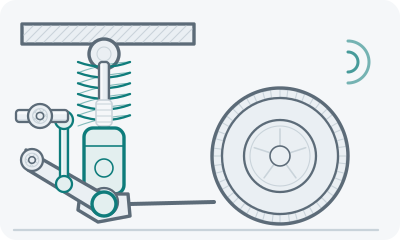
A suspension knock rarely calls for an immediate tow, but it always calls for an answer to the question “what exactly is knocking”. A lift is not essential for a first approximation: most chassis parts can be checked on level ground with your hands, a bounce test and a short controlled drive. Below is a four-step sequence that narrows the list of suspects from “the whole suspension” to one or two specific parts. You will need a torch, gloves and — for some tests — a jack and a helper.
Step 1. Build a portrait of the sound
Before crawling under the car, spend a week simply listening. Answers to a few questions rule out half the options:
- Where it knocks — front or rear, left or right. An open window and a slow pass along a wall or parapet help: the sound reflects and becomes clearer.
- What it knocks on — washboard tarmac and expansion joints, or single potholes and speed humps. Frequent sharp knocking on small stuff and single dull impacts on big bumps give different lists of causes.
- What changes the sound — corners, braking, pulling away, a loaded boot, warming up. A knock that disappears in a corner as the body leans one way is the classic signature of an anti-roll bar link.
The general picture is on the symptom page knocking in the suspension, and the specific case of small bumps on knocking over bumps.
It is also worth ruling out false sources: an unsecured jack and tools in the boot, a loose spare wheel, objects in the door pockets and on the parcel shelf. A noticeable share of “suspension knocks” turn out to be luggage tapping against the body — five minutes of clearing the boot is cheaper than any diagnosis.
Step 2. The bounce test
Over each wheel in turn, rock the car vigorously by a wing or bumper and listen. A creak, knock or click while rocking localises the problem corner, and the way the body behaves after you let go says something about the dampers: a healthy strut settles the movement in one motion.
The bounce test catches strut top mounts (a creak from above), ball joints (a knock from below) and tired dampers well. Silence during the test disproves nothing: many parts need an impact, not a gentle push.
Step 3. Checks by hand
Next, the parts you can reach without a lift. Gloves, and for some tests a helper.
- Anti-roll bar links. The bar ties the left and right wheels together to limit body roll; the links are its jointed rods and the main supplier of knocking on washboard surfaces. On many cars you can reach a link behind the wheel with the steering on full lock: rock it by hand — play and knocking are felt straight away.
- Track rod ends. A helper rocks the steering wheel in short movements with the engine running while you hold a palm on the track rod end behind the wheel. Thumps and clicks into your palm mean play in the joint.
- Ball joints. A full test needs a jack — rocking the raised wheel by the top and bottom.
- Anti-roll bar bushes and control arm bushes. Inspect with a torch: cracked rubber, squeezed-out or torn bushes, rusty streaks from the joints.
- Fasteners and the undertray. Loose engine undertray bolts are a banal and very common cause of clatter over potholes. While your gloves are on, check the visible suspension fasteners and the arch liner clips.
Step 4. The controlled drive
The final step is a drive along a familiar route with changing surfaces. The aim is to test the hypothesis, not to gather new impressions: if you suspect an anti-roll bar link, the knock should disappear as the body leans; a damper, grow over a series of undulations; the steering, respond to small corrections. A helper is useful: the driver watches the road, the passenger listens and records the sound on a phone by the relevant arch.
A few standard manoeuvres on an empty road complete the picture: gentle braking (a knock as the nose dips — bushes or track rod ends), pulling away (a single thud — a ball joint or an engine mount), a slow slalom (noises as the body leans — the anti-roll bar and its links). All of them at speeds that are safe for everyone else: the goal is to hear the sound, not to hit a pothole flat out.
Summary table
| How the knock shows | First suspects | Quick check |
|---|---|---|
| Frequent and sharp, on washboard and joints | Anti-roll bar links | Rock the link by hand |
| Dry and metallic, on small potholes | Ball joint, track rod ends | Vertical play, rocking the steering |
| Dull and single, in big potholes | Control arm bushes, bump stops | Inspect the joint rubber |
| Knock from above, felt through the body | Strut top mounts | Creak during the bounce test, crunch when steering |
| Metallic clatter after potholes | Loose fasteners, undertray | Inspect and tighten |
| Knock plus body wallowing over undulations | Dampers | The bounce test |
The table is about probabilities, not verdicts: suspension parts work together, and a worn damper, for instance, accelerates the wear of everything else. If the knock comes from the rear, the candidates shift: there it is more often beam or arm bushes, anti-roll bar bushes and dampers, and on a multi-link rear suspension the list of joints is even longer than at the front.
When a lift is unavoidable
Home tests have a limit. Rear beam and arm bushes often need loading with a pry bar from below; early wheel bearing play is caught on a spinning raised wheel; hidden cracks in springs are only visible on a clean inspection. If the list has not narrowed after four steps, or the suspicion concerns the rear suspension, a lift is the sensible next stop — and against the price of even one part replaced for nothing, that inspection is cheap insurance.
A special case is a knock that appeared right after a repair or a tyre change: then the places recently touched come first, from wheel bolt torque to how the removed parts were refitted.
If the knock still refuses to be localised, there is one more tool: record the sound while driving in the Pro-Stuk app. It matches the recording with your answers about when and on which surfaces the knock appears and shows the likely causes with an urgency level — a convenient starting point both for the garage check and for the conversation with a mechanic.
