

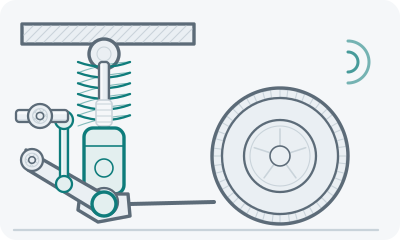
A knock at the front on small bumps is probably the commonest suspension complaint: the car is silent over speed humps and big potholes but answers with a chatter on expansion joints, washboard surfaces and tram rails. That is not an accident but a useful clue: this character of knock narrows the list of suspects considerably. Here is why it knocks on small stuff specifically and which parts to check first.
Why it knocks on small bumps
A small bump forces the suspension into fast, small-amplitude movements. If play has appeared in a joint — a clearance between worn parts — every such movement shifts the parts within that clearance, and you get an impact. Dozens of bumps a second, and the individual impacts merge into the characteristic chatter.
On a big pothole or a long undulation the picture is different: the suspension is loaded by a large force, the clearance is taken up in one direction, and there is nothing left to knock. So “knocks on the small stuff, silent over potholes” is the typical handwriting of a small amount of play, most often in the anti-roll bar or steering joints, rather than a sign of something destroyed.
Broken secondary roads and gravel make this scenario especially common: they give the joints thousands of cycles per kilometre, winter road salt eats the boots, and swings between hard frost and summer heat age the rubber faster than a mild climate does. So a small amount of play in the front suspension appears earlier than the maker’s schedule promises — and a knock on small bumps becomes the first signal long before the wear is visible to a mechanic on a lift.
The main suspects
| Part | Character of the knock | Additional signs |
|---|---|---|
| Anti-roll bar links | Frequent dull chatter on small stuff | Quietens in smooth bends |
| Anti-roll bar bushes | Dull knock, sometimes with a creak | Audible when the parked car is rocked |
| Strut top mounts | Single knocks “from above”, under the wing | Clicks when steering while parked |
| Track rod ends and tie rods | Fine knock felt in the wheel | Steering play, knock when steering parked |
| Control arm bushes | Dull knock, not always rapid | The car wanders, uneven tyre wear |
| Not the suspension: undertray, exhaust, luggage | Rattle, clatter | Independent of steering and braking |
Top of the list are the anti-roll bar links: small rods with joints connecting the anti-roll bar to the suspension. On rough roads they rarely survive 60–70 thousand kilometres, and they knock exactly this way — fine and frequent. Their signs and checks are covered in signs of worn anti-roll bar links and checking anti-roll bar links for knocking.
The second commonest source is the rubber-metal joints, the suspension bushes: rubber sleeves pressed into the arms. Their wear develops more slowly and sounds duller; there is a separate breakdown in signs of worn suspension bushes and front control arm bush wear symptoms.
Narrowing it down without a lift
A few observations on the move and five minutes in a car park give a mechanic more than an abstract “it knocks at the front”:
- The cornering test. If the knock quietens in a smooth bend, the anti-roll bar links are very likely: in a bend their joints are loaded and the play is taken up.
- Steering while parked. Turn the wheel lock to lock with the car stationary. Knocks and clicks without movement point at the strut top mounts, the track rod ends or the steering rack; a similar picture is described on the symptom page clicking when steering.
- Braking. A knock that appears or changes under gentle braking over a bump more often points at the arm bushes or play in a ball joint.
- Bouncing and rocking by hand. Bounce the car energetically by the wing and listen; then find the anti-roll bar link behind the wheel and rock it by hand — play and clicks can be felt with your fingers. The complete home method is in finding a suspension knock without a lift.
It is worth writing the observations down in three lines: at what speed, on what kind of bumps, and what changes in bends and under braking. With that input a diagnosis on a lift takes minutes. Neighbouring causes and sounds are collected on the symptom pages knocking over bumps and knocking in the suspension.
How the repair is decided
The order runs from the cheapest and most likely to the most expensive: the anti-roll bar bushes and links first, then the top mounts, then the steering joints, and only then the arm bushes. That order is not cost-cutting but logic — the parts at the top of the list wear fastest and are checked in minutes.
The spread in labour has a simple explanation: the same operation takes different times on different models, and seized fasteners can double it. On some cars a bush is pressed out and replaced, on others only the complete arm is available — worth asking which case yours is before comparing quotes, because it changes the arithmetic entirely.
Two things mechanics do not always mention. Any work on the track rod ends or the arms ends with an alignment, and it belongs in the budget from the start. And rubber bushes are finally torqued with the car’s weight on its wheels, not with the suspension hanging: tightened hanging, the rubber lives twisted and tears within months.
What not to do
Do not replace parts “by the sound” without an inspection: half a dozen components give a similar noise, and guessing often means a second visit with the same knock. Do not silence the problem with temporary measures — greasing joints or tightening things “just in case”: grease does not remove play in a worn joint. And do not drive for months “until it falls off”: a knock masks the arrival of new faults, and a worn part accelerates the wear of its neighbours.
If you want to arrive at the workshop with a theory ready, record the knock in the Pro-Stuk app: it matches the sound with your answers about when it appears and shows the likely causes with a level of urgency — the conversation with a mechanic becomes specific straight away.
