

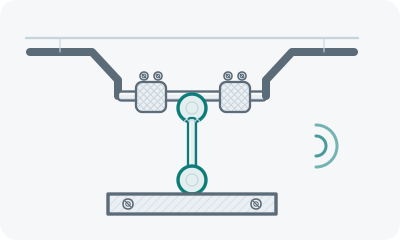
A fine, frequent knock from the front on broken tarmac that disappears the moment you reach a smooth road is the most common suspension complaint — and the most common reason for unnecessary spending. The usual culprits are the anti-roll bar links: short rods with joints at each end connecting the anti-roll bar to the suspension. The good news is that you can check them yourself, and the repair is cheap.
What the part does and why it knocks
The anti-roll bar is a springy steel bar across the car. In a corner it ties the left and right wheels together and stops the body leaning too far. It cannot work directly with the suspension, so it connects through two short rods — the links. At each end is a ball joint in a plastic liner under a rubber boot.
The joint wears in the classic pattern: the boot cracks, water and sand get in, the grease washes out, the liner wears and a clearance appears. Over small bumps the suspension moves quickly with small amplitude — and those are exactly the conditions in which play in the joint is heard best. Hence the sound portrait: frequent, sharp, different on each side, at 20–50 km/h, silent on smooth roads. The signs by stage are in signs of worn anti-roll bar links.
Checking in ten minutes
- Rock the link by hand. Find the link behind the wheel, take hold and move it along its axis. A healthy link feels solid; a worn one gives noticeable movement and a click.
- Rock the body. Have a helper push the wing up and down while you keep a palm on the joint: play transmits into your hand as distinct thumps.
- Check the boots. A torn boot is practically a guarantee of wear to come, even if there is no play yet.
- Drive over washboard. A fine frequent knock from one side with silence on smooth tarmac fits the diagnosis.
| Check | Anti-roll bar links | Arms and dampers |
|---|---|---|
| Type of bump | Fine washboard, joints | Large potholes, undulations |
| Character of the sound | Frequent sharp rattle | Dull single thump |
| Reaction to rocking the body | Clicks in the joint under your hand | Creak or dull knock in the strut |
| Behaviour in a corner | Knock as you change steering direction | Roll and body float |
What knocks similarly
If the knock is dull, appears on large potholes and the car holds its lane worse, the control arm bushes are more likely — their picture is in front control arm bush wear: the symptoms. If the body keeps rocking after a speed hump and the stopping distance has grown, look at the dampers: how to tell shock absorbers are dead. The general breakdown of similar sounds is on the symptom pages knocking in the suspension and knocking over bumps.
The anti-roll bar bushes deserve a separate mention — the rubber blocks that hold the bar to the body. They give almost the same rattle, cost very little and are replaced in half an hour, so they are checked at the same time as the links: signs of worn anti-roll bar bushes.
How the replacement is decided
This is one of the cheapest suspension jobs, and replacing anti-roll bar links does not disturb the alignment, so there is no need to pay for one afterwards.
Two practical points. The ball stud usually has to be held with a hex key or a spanner flat while the nut is undone; where the fastener has seized and is cut off, the replacement nut and bolt should be proper parts rather than whatever fits. And ask for the bushes to be assessed at the same time — replacing the links while leaving worn bushes leaves half the rattle in place.
The condition is not an emergency: worn links spoil the car’s behaviour in sharp manoeuvres but do not fail suddenly. Still, a ruined joint wears its neighbours and spoils the car, while the repair costs noticeably less than any other suspension job — so there is no sense in dragging it out.
If the knock is audible but you cannot catch the play by hand, record a run over washboard in the Pro-Stuk app. It matches the character and frequency of the impacts with your answers about speed and surface and shows the likely causes with percentages — easier to discuss at a workshop than “something rattles up front”.
