

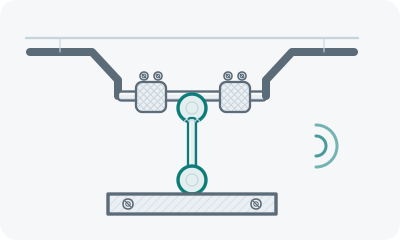
Anti-roll bar links are the first thing a mechanic checks when an owner complains of a knock in the suspension. They are small rods with joints connecting the anti-roll bar — the springy bar that reduces body roll — to the wheel’s suspension. The part is cheap and quick to replace, and on broken roads it wears more often than almost anything else in the running gear. Below: the signs of wear, how to check the links without a lift, and what decides the replacement.
How a link is built and why it knocks
An anti-roll bar link is a rod 10–30 cm long with ball joints or bushes at each end. As the body rolls, the anti-roll bar twists and pulls the unloaded side of the suspension up through the links. The joints work at small angles constantly — thousands of cycles per kilometre of rough road.
What wears is usually not the rod but the joint: the plastic liner is worn away, play appears, and the pin starts to flop in its housing. Every small bump turns that play into an impact — hence the characteristic frequent knock. A torn boot speeds it up: dust and water grind the joint away within a few thousand kilometres.
The main signs of wear
- A frequent dull knock over small bumps. Expansion joints, washboard surfaces, tram rails, speed humps at low speed. On large potholes the knock can even be less noticeable than on small stuff.
- The knock goes quiet in a turn. In a corner the anti-roll bar is loaded and the play in the joint is taken up, so there is nothing left to knock. That is the links’ main distinguishing feature.
- The knock is more often at the front, on the side of the worn link, and does not depend on braking or acceleration.
- Increased roll and a vague feel in corners. Noticeable at a late stage, when the play is large or the link has broken: the car leans more and needs correcting.
- Creaking over bumps — heard when the joint has dried out but is not yet broken.
If that picture is familiar, compare it with the description on the symptom page knocking over bumps, where the neighbouring causes with a similar sound are covered too.
The stages of wear
| Stage | What you hear and feel | What to do |
|---|---|---|
| Early | Occasional single knocks on small stuff, boot intact | Check at the next service |
| Middle | Constant frequent knock, quiet in corners | Diagnosis and replacement within a couple of weeks |
| Late | Knock over any bump, roll noticeably increased | Replace without delay |
| Broken | The knock has gone, but the car leans in corners | Workshop: the anti-roll bar is not working |
Note the last row: a broken link can stop knocking altogether. Silence after a long period of knocking is not recovery but a reason to look under the car. What happens next is set out in what happens if you do not replace anti-roll bar links.
How to check them yourself
No lift is needed for the basic check:
- Rocking by hand. With the car parked, find the link behind the front wheel (turn the steering for easier access) and rock it firmly. Perceptible play or clicks in the joint mean wear. A healthy link moves stiffly and silently.
- Inspecting the boots. A torn or cracked joint boot is a reason to prepare for replacement even before a knock appears.
- The helper test. A helper rocks the car by the wing while you listen at the wheel. The links’ knock sounds like frequent metallic clicks around the anti-roll bar.
- Listening on the move. Drive slowly over a washboard surface or gravel: links answer with a fine, frequent chatter rather than single thumps.
At a workshop the diagnosis is confirmed on a lift: the mechanic rocks the link with a pry bar or by hand with the wheel raised, and the play is immediately visible and audible. The check takes a few minutes and is usually free when you book the replacement. Do not ask for a replacement “because it knocks” without an inspection: several other parts make a similar sound, and it is better for the mechanic to show you the play.
Anti-roll bar bushes, track rod ends and worn dampers knock similarly — their signs are in how to tell shock absorbers are dead and on the symptom page knocking in the suspension.
How the replacement is decided
This is one of the cheapest suspension jobs, and no alignment is needed afterwards — the part does not affect the wheel angles. The work takes 20–40 minutes a side on most models; it takes longer when the fasteners have seized and have to be worked with penetrating oil or cut off, which is what the upper end of any quote reflects.
Two practical points. First, a link’s ball stud usually has to be held with a hex key or a spanner on a flat while the nut is undone — a joint spun round with an impact gun is destroyed as it is removed, which does not matter for the old one but does if the mechanic reuses hardware. Second, if the fastener was cut off, the new nut and bolt should be proper replacements rather than whatever fits.
Is it worth putting off
Anti-roll bar links are not brakes: their wear does not usually create a sudden emergency. But ruined joints finish themselves off with every kilometre, the knock masks other suspension faults, and with a broken link the car holds its line noticeably worse in a sharp manoeuvre. Given how cheap the part is, saving on the replacement is rarely justified.
If you are not sure it is the links knocking, record the sound in the Pro-Stuk app: it matches the recording with your answers and shows the likely causes with an urgency rating — with that list the conversation with the mechanic gets specific.
