

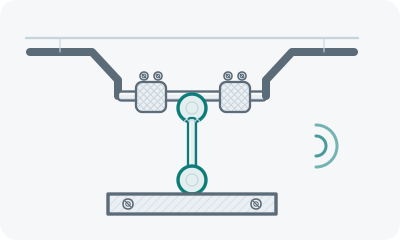
Anti-roll bar links knock for weeks and months while the car keeps driving — so the temptation to put the job off is understandable. The short, honest answer: there will be no catastrophe, and a wheel does not come off because of them. But the anti-roll bar — the torsion bar that holds body roll in check — gradually stops doing its job, and that shows up in the handling exactly when you need it most. Here is what happens, in order.
The short answer
A worn link means play in the joint that connects the bar to the suspension. While the play is small, the consequence is limited to a knock. From there things escalate: the play grows, the bar reacts late, roll increases, and finally the joint breaks up and the link snaps — the bar simply switches off on that side. The brakes, the steering and the wheel mounting are all still fine, so this is not about a sudden accident. It is about losing stability gradually and paying more than you needed to.
How it develops
| Stage | What is happening | Where it leads |
|---|---|---|
| First weeks | Slight play, knocking on small bumps | Discomfort, almost nothing else |
| One or two months | Play grows, the knock is constant | More roll, a looser car in corners |
| Neglected stage | Joint broken up, boot torn | Knocking on any road, late steering response |
| Link snaps | The bar does not work on one side | Heavy roll, wallowing, the link hitting the arm or driveshaft |
The pace is individual: on smooth roads a worn link can survive a long time; on gravel and washboard surfaces it can break up within a couple of thousand kilometres. A torn boot speeds the process up several times over, because dust and water get into the joint.
A word on the break itself: usually the link does not fly apart. It works loose until the stud pops out of the joint housing, or the threaded section wears through. It typically happens over a bump under load. The driver notices not a bang but a change in behaviour — the car suddenly leans much more in corners, even though the familiar knock has gone.
What suffers besides comfort
Handling in manoeuvres. The bar earns its keep in corners and in sudden lane changes. With worn links it acts later and more weakly: the car leans further, settles into the corner later, and behaves less predictably in an emergency swerve. In ordinary driving this is almost invisible — and that is the trap: the stability margin shrinks without the driver noticing.
Electronic aids. Stability control (ESP) is designed around a healthy suspension. It keeps working, but a car with more roll needs more corrections — on a slippery winter road that means interventions in places where a healthy car would simply have driven through. It will not switch the aids off, but it eats into what they can do.
Neighbouring parts. A broken or badly worn link swings about and can hit the arm, a driveshaft or a tie rod. Constant vibration wears the anti-roll bar bushes — the rubber mounts the bar turns in — faster than they should. Often, by the time the owner gives in, the job is no longer a pair of links but links plus bushes.
Diagnosing everything else. A constant knock from the links masks the rest of the suspension. It is easy to miss a shock absorber or a control arm bush starting to knock behind it — and those are more expensive and more important parts. How their symptoms differ is described on the symptom page knocking in the suspension.
Can you drive, and for how long
You can, with caveats:
- in calm town driving, knocking links tolerate weeks; this is not a reason to leave the car parked;
- on a main road, keep the extra roll in mind: fast corners and sudden lane changes are the weak point of a car whose bar is not working;
- “the knock went away on its own” is a warning sign, not a recovery: that is what a snapped link sounds like, and after it there is nothing left to wait for;
- before a long trip, worn links are worth replacing: the cost of the job is nothing next to the cost of the journey;
- in winter the margin is shorter: on a slippery road the extra roll and the late steering response arrive sooner and harder than on dry tarmac.
The one scenario you cannot postpone at all is a link that has come away and is hanging loose. It swings next to the driveshaft, the brake hose and the ABS sensor, and every kilometre is a lottery over what it catches. If you find a free-swinging link under the car, drive only as far as the nearest workshop.
A useful habit is to listen to the suspension once a season on a familiar stretch of small bumps: changes in the sound are obvious in comparison. The full range of chassis noises is on the symptom page knocking over bumps.
Why waiting costs more
The paradox of anti-roll bar links is that this is one of the cheapest jobs in the whole suspension — a small part and a short job on most cars. Postponing it adds items to the bill: the bar bushes, once vibration has destroyed them; a second diagnosis, when the knock from the links hid another part; and occasionally a torn driveshaft boot or brake hose that the detached link has been beating against. A month of saving turns into a double invoice.
There is a less obvious cost too — tyres. A car whose bar is not working leans harder onto the outer wheel in corners, and the shoulder blocks of the tread wear faster. The effect is not dramatic, but next to the price of a pair of links it is one more argument against waiting.
If the knock is there but you are not sure of the diagnosis, record the sound in the Pro-Stuk app. It matches the recording against your answers about the character of the knock and shows the likely causes with an urgency rating: you will know whether this is a cheap pair of links or something more serious.
