

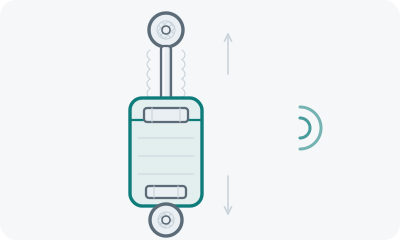
A damper is the part that absorbs the spring’s oscillation and keeps the wheel pressed to the road. Unlike anti-roll bar links or a wheel bearing, it rarely announces itself with one vivid symptom: its effectiveness fades gradually and the driver quietly gets used to a car that has started to float. Below are the signs that catch the wear objectively, the checks you can do without a test rig, and what decides the replacement.
How a damper works and why the wear is invisible
The suspension spring compresses on a bump and wants to spring back — without resistance the body would rock like a boat. The damper creates that resistance: a piston on a rod forces oil through calibrated valves, turning the energy of the oscillation into heat.
The valves, the rod seals and the oil itself all wear. The process is spread over tens of thousands of kilometres, so “it was fine yesterday and bad today” almost never happens with dampers — except after a hard pothole strike or oil lost through the seal. The practical conclusion: trust specific signs rather than a feeling that everything is as it always was.
A note on terms: a strut and a damper are not the same thing. The damper is the damping element; a strut (a MacPherson type, for instance) is the complete assembly where the damper is combined with the spring and the top mount and forms part of the suspension.
Eight signs of wear
- Floating after a bump. A healthy suspension absorbs the oscillation in one or one and a half movements. If the body rocks two or three times after a speed hump, the dampers have done their time.
- Nose-diving under braking and squatting under acceleration. The front dives deeply at every ordinary stop, the rear squats when you pull away.
- Bottoming out. Dull hard impacts in potholes the car used to swallow: the spring compresses onto the bump stop because the damper is not resisting in time.
- Knocking. A worn damper can knock itself (piston play, worn mounting bushes) — a duller sound over medium and large bumps. Other parts knock similarly; the lookalikes are on the symptom page knocking in the suspension.
- Oil weeping on the body. A wet body and dirt trails on the boot mean the rod seal is passing oil. Light misting means watch; a clear leak means replace.
- Patchy tyre wear. A wheel that skips over bumps wears the tread unevenly — in patches around the circumference.
- Uncertainty at speed. The car floats in its lane, follows ruts, needs constant corrections and leans more than it used to in corners.
- A longer stopping distance on rough surfaces. The wheel leaves the road more often and the ABS works earlier and longer, as covered in driving with dead shock absorbers.
No single sign is a verdict, but two or three from the list are a solid reason for a diagnosis.
What it is easily confused with
| Sign | What else it resembles | How to tell |
|---|---|---|
| Knock over bumps | Anti-roll bar links and bushes, control arm bushes | The links’ knock is fine and frequent and quietens in corners; a damper’s is duller and less frequent |
| Floating, roll | Sagged springs | Springs show as lost ride height; dampers show as floating |
| Bottoming out | Broken bump stops, sagged springs | Inspection on a lift: the state of the bump stops and spring height |
| Wandering in the lane | Alignment, worn tyres, steering play | Check the wheel angles and play before replacing dampers |
The most common neighbour by symptoms is the anti-roll bar links: they also knock over bumps, but their sound is finer and more frequent. The detailed breakdown is in signs of worn anti-roll bar links, sagged springs in signs of worn suspension springs, and bottoming out in signs of worn bump stops.
How to check them yourself
- Inspection. Turn the wheels and look at the damper bodies: oil weeping, a rusted or torn boot, impact marks. Look at the tread while you are there — patchy wear is visible and can be felt.
- The bounce test. Push firmly down on a corner of the body and release: a healthy suspension returns in one movement, a worn one keeps rocking. The method with its caveats is in checking shock absorbers with the bounce test, and the wider set of signs in how to tell shock absorbers are dead.
- The road test. On an empty stretch, brake smoothly from 60 km/h: excessive dive and floating after the stop speak for themselves.
- A workshop rig. A shaker rig measures how well each wheel keeps contact and gives numbers per corner. Useful in disputed cases, but it does not replace an inspection.
Damper life on broken roads is roughly 60,000–100,000 km; past that, the bounce test and an inspection are worth doing at every service. A separate reason for an unscheduled check is a hard pothole or kerb strike: an impact can bend the rod or damage the valves, and the damper fails in one go with no gradual decline.
How the repair is decided
Dampers are replaced in pairs on an axle — a car with differently worn dampers holds the left and right sides unequally.
Two things worth settling before the job. First, whether the strut will be stripped: on most front struts it will, which is the moment to renew the top mount bearing, the bump stop and the boot for the price of the parts alone. Second, whether an alignment follows — on most cars the front geometry is disturbed when a strut comes off.
On parts, cheap dampers vary far more in valving than in appearance; a mismatched pair, or a very soft aftermarket unit on a heavy car, floats again within a season. Matching the damper to the car and to how it is used matters more than the badge.
If the suspension knocks and the source is not obvious, record the sound in the Pro-Stuk app: it matches the recording with your answers about when and how the sound appears and shows the likely causes with an urgency rating.
