

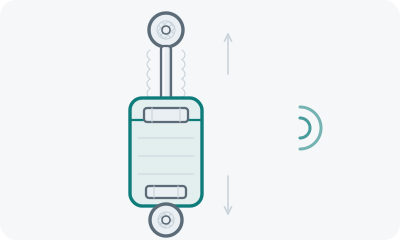
A bump stop is a small part that comes to mind last. It is a compression buffer: a springy cylinder of polyurethane or microcellular foam fitted over the damper rod. When the suspension runs out of travel in a deep pothole or under load, it is the bump stop that halts the compression gently and stops metal striking metal. Over time it crumbles, tears or simply disappears — and the suspension starts bottoming out hard. Here are the signs of wear, how to check, and what decides the repair.
How wear shows itself
- Dull hard thumps in potholes. The main symptom: on a deep bump the suspension bottoms out with an impact felt through the body and the steering wheel. Over small stuff the car rides normally.
- A thump when fully loaded. With passengers and luggage, bottoming out appears even on moderate defects — the suspension, already compressed by the weight, reaches the end of its travel sooner.
- Crumbs in the strut tower. Yellow-grey crumbs of foam appear under the bonnet around the top mount — the remains of a disintegrated bump stop.
- The knock has become sharper. Without a buffer, the end of the spring coil or the rod contacts the mount hard, and bumps take on a metallic edge — the general breakdown of such sounds is on knocking over bumps.
It is important to understand that bump stops almost never wear alone. They die either of age — the material perishes and crumbles — or because the suspension bottoms out too often, thanks to tired springs or dead dampers.
Age matters here as much as mileage. Foam loses its elasticity from temperature swings, oil and road chemicals: on a car older than ten years the bump stops often crumble to dust at the first touch even if the mileage is modest and the roads were smooth. So on a used car of that age their condition is worth checking by default.
Bump stops or something else
| Symptom | Bump stops | A similar fault |
|---|---|---|
| Hard impact only in deep potholes | Yes, typical | Sagged springs — but with lost ride height |
| Constant knocking over small bumps | Not typical | Anti-roll bar links, control arm bushes |
| Body floating after a bump | No | Dampers |
| Knock when steering while parked | No | Top mount bearing, ball joint |
| Crumbs in the strut tower | A definitive sign | — |
The ball joint deserves a separate mention — the pivot connecting the arm to the hub: its knock is also heard over bumps, but play and clicking in turns join it, as described in how to check a ball joint yourself.
How to check it yourself
A bump stop is only fully visible with the strut apart, but an indirect check is open to anyone. Look into the strut towers under the bonnet: crumbs and foam dust are a verdict. Then bounce each corner of the car firmly downwards: springy resistance with a soft stop is normal; a hard jab at the end of travel means probable metal-to-metal contact.
It is worth listening to the car on a familiar road too. If hard impacts appear only on deep defects while small stuff is quiet, the picture fits the bump stops. If the clattering comes on any washboard surface, the source is more likely the anti-roll bar or the fasteners — that case is covered in clattering under the car over bumps.
On a lift the picture is fuller: with the suspension hanging you can see the boot — the pleated cover over the damper rod, inside which the bump stop lives. A torn or slipped boot almost always means the buffer under it is in a bad way too.
What driving with broken bump stops leads to
Every bottoming-out without a buffer is a shock load along the whole path from the wheel to the body. The damper suffers first: its valves and rod were not designed for a hard stop, and oil weeping appears. Then the top mount bearing and the upper strut mount, and then the mounting points in the body start to tire. A torn boot — often part of the same kit as the bump stop — exposes the damper rod to sand and water, the mirror-finish surface pits, and the seal stops holding oil. What it leads to is set out in driving with dead shock absorbers.
The outcome is predictable: saving on a part that costs very little turns into replacing dampers.
How the repair is decided
Bump stops and boots are among the cheapest suspension parts; they are usually bought as a protection kit per axle. The main cost is labour, because the strut has to come off and be stripped with spring compressors. Which leads to the practical rule: they are fitted essentially for free when the dampers are being replaced anyway, and cost a full strut strip when they are not.
The same visit is the moment to decide on the top mount bearing: if it has covered more than 100,000 km, doing it now costs the price of the part alone.
On choosing parts the rule is simple: buy a bump stop designed for your specific model, not a universal “roughly right” one. The buffer’s length is a calculated value: too short and the suspension bottoms out onto metal, too long and the ride is stiff and the buffer works permanently in compression, destroying itself within a season. Kits from the major damper manufacturers include a bump stop and a boot of the correct geometry.
Not sure that the dull thumps in potholes really are the bump stops? Record the sound in the Pro-Stuk app: it matches the recording with your answers about how the car behaves and shows the likely causes with percentages and an urgency level — so you arrive at the workshop with a working theory.
