

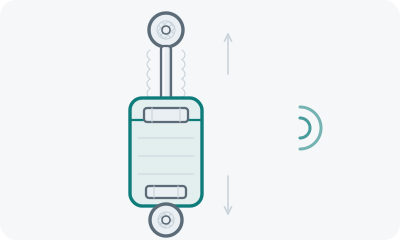
A damper controls the movement of the spring — without it the suspension becomes a trampoline that keeps bouncing after every bump. The problem is that it dies gradually and invisibly: the driver adapts to the changing behaviour week by week and at some point accepts as normal something that is not. Here is what actually happens to the car, and to the money, if you leave it as it is.
What the car loses on the road
The main consequence is loss of contact between tyre and road. A bouncing wheel spends part of its time in the air or under reduced load, and during those moments it transmits neither braking nor cornering force. In practice that looks like this:
- stopping distance grows, especially on uneven surfaces;
- the car floats in corners and answers the steering late;
- on the motorway it wanders and needs constant small corrections;
- the ABS intervenes earlier and more crudely, because the wheels are skipping;
- on undulating tarmac the body starts to build up its own rhythm.
Aquaplaning deserves a separate mention: a bouncing wheel clears water less effectively, and the threshold at which the car starts to float arrives sooner.
The insidious part is how smoothly the degradation happens. A damper loses effectiveness over years, the driver adapts to the new behaviour — braking earlier, entering corners more gently, holding the wheel more firmly on the motorway — and never notices that the safety margin has already been spent. The difference usually becomes obvious only after the repair, when the car stops floating.
What breaks next
| Part | What happens to it |
|---|---|
| Springs | Work in conditions they were not designed for, break more often |
| Control arm bushes | Destroyed by constant impact loads |
| Anti-roll bar links and bushes | Wear out in months rather than years |
| Strut top mounts | Take impact loads and start to crunch |
| Wheel bearings | Accelerated wear from alternating loads |
| Tyres | Patchy wear, a sawtooth pattern |
The last row is the most tangible in money. A set of tyres eaten away in patches within a single season costs about as much as a pair of dampers, sometimes more.
Making sure they really are dead
The classic bounce test — press down on a wing with your weight and let go — works less well than people think: a modern damper can pass it having already lost half its effectiveness. It is more reliable to look at the combination of signs: oil traces on the body, knocking over bumps, the body rocking for more than one cycle after a speed hump, uneven tread wear, changed behaviour on the motorway.
An instrumented test on a damper tester gives an objective picture but is not available everywhere. The compromise is an inspection on a lift, where the neighbouring parts get checked at the same time: it almost always turns out that the dampers did not die alone. The set of noises this conversation usually starts from is on the symptom page knocking over bumps.
How the repair is decided
Dampers are replaced by axle. Different damping left and right causes pulling under braking, and half the point of the repair is lost.
Two things belong in the estimate and are worth asking about. The strut top mounts and bump stops: they are only accessible with the strut dismantled, they wear along with the damper, and doing them later means paying for the same disassembly twice. And wheel alignment afterwards — not an option but a required step, because replacing struts changes the geometry.
One more question that decides how the car will feel: whether the replacements match the original specification. Mixing a stiff aftermarket damper on one axle with the original on the other produces a car that behaves differently front and rear, and that is harder to live with than the tired set you started from.
If you are unsure whether the suspension is knocking or this is simply normal for your car, record the sound in the Pro-Stuk app on a familiar rough stretch. The app matches the recording with your answers and shows the likely causes with percentages — usually enough to decide between going for a diagnosis now and waiting for the next service.
