

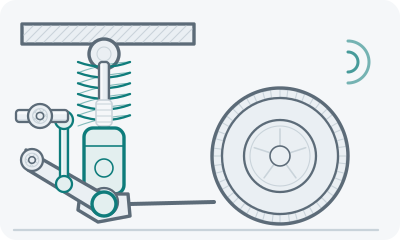
Clattering from underneath over bumps is one of the most common complaints on broken roads, and one of the most rewarding: in most cases the cause is cheap. What rattles is usually not the arms or the hubs but the small stuff — anti-roll bar links, loose undertray bolts, exhaust mountings. That is exactly why the sound should not be ignored, though: occasionally the same picture masks something serious. Here are the sources by frequency, the ways to check, and where the line is.
The most common sources
- Anti-roll bar links. Short rods connecting the anti-roll bar — the torsion bar that limits body roll — to the suspension. Their joints are the first to be destroyed by washboard surfaces, and they give a rapid, dry knock on small bumps.
- Anti-roll bar bushes. The rubber clamps holding the bar to the body. Worn bushes knock dully when the body is twisted — dropping off a kerb with one wheel, for instance.
- The undertray. Loose bolts or lost rubber dampers, and a steel sheet clatters on every bump, with the sound coming up through the driver’s floor.
- The exhaust system. Sagging rubber hangers let the pipe strike the body or the subframe; rattling heat shields often join in.
- Control arm bushes. Rubber-and-metal joints with torn rubber give a dull single knock in potholes.
The general picture of noises from underneath, sorted by sound, is on the symptom page rattling under the car.
Telling the sources apart by character
| Sound | When you hear it | Likely source |
|---|---|---|
| Rapid dry knocking | Washboard tarmac, broken asphalt | Anti-roll bar links |
| Dull knock as the body twists | Kerbs, diagonal potholes | Anti-roll bar bushes, control arm bushes |
| Metallic clang of a sheet | Any bump, felt through the floor | The undertray |
| Rattle with a metallic ring | Bumps plus certain engine speeds | Heat shields and exhaust mountings |
| A single hard impact | Deep potholes only | Bump stops, sagging springs |
One more clue is speed. If the noise grows with speed and appears even on smooth roads, the exhaust and its shields are the likelier suspects — that scenario is covered in rattling under the floor at speed. A knock strictly over bumps that vanishes on smooth tarmac is almost always suspension or fasteners; compare your description with the page knocking over bumps.
Finding the source yourself
Start with the simple thing: stop, open the boot and remove everything that could rattle — the jack, tools, bottles. A wheel brace in the spare wheel well produces a surprisingly suspension-like sound, and an unsecured spare knocks reliably on every series of bumps.
Next, the stationary test. Rock the body vigorously by a wing over each wheel: a knock while rocking points to the side. Ask someone to rock the car while you listen from underneath by the wheel — on safe, level ground and without a jack.
Third, your hands. With the car cold, shake the undertray and the visible parts of the exhaust: play, metal knocking against metal or a dangling hanger turns up within a couple of minutes. An anti-roll bar link can be rocked by hand with the wheel raised — a healthy joint has no play at all.
And one more clue: the route. Drive the same familiar bump at different speeds and with different loads. A noise that disappears with passengers in the back is usually free play in the suspension, while a clatter that does not care about the load is fasteners.
When the clatter is serious
Cheap causes are the majority, but not all of them. Pay attention if at least one of these joins in:
- the knock reaches the steering wheel, or the wheel shivers over bumps — there may be play in the track rod ends or the steering rack;
- the car wanders off a straight line and has to be caught after potholes — the arms and their joints come under suspicion;
- the noise has become daily and louder within a week or two — that is how worn ball joints behave, and a ball joint failing at speed means losing the wheel out of your control;
- the clatter has spread from small bumps to any bump — the play has grown.
In those cases the diagnosis is not postponed: the stake is no longer comfort but control. An inspection on a lift closes all the theories at once.
How the repair is decided
The good news is that the typical causes of clattering are among the cheapest jobs on a car. One practical rule: replace anti-roll bar links in pairs — the second one is usually close behind, and doing the other side while the car is already on the lift adds very little.
Two things are worth asking about. If the undertray fasteners have rusted away, ask whether the tray is being bolted back with new mounts or simply tightened onto what is left — the second option comes back within months. And if a control arm bush is the culprit, ask whether the bush alone can be pressed out or whether the whole arm is needed on this car: the answer changes both the price and the time, and it is a legitimate question rather than an upsell.
If the clatter refuses to be pinned down, record it in the Pro-Stuk app while driving your familiar broken road: the app matches the sound against your answers about when it appears and shows the likely causes with an urgency level — leaving the workshop only to confirm the theory on a lift.
