

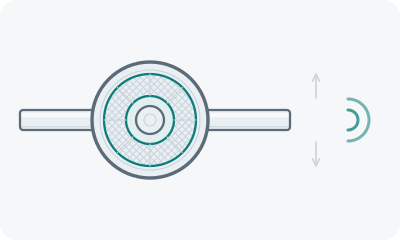
A suspension bush is a rubber-to-metal joint: two steel sleeves with rubber vulcanised between them. Suspension arms attach to the body through these joints, and it is the rubber that damps vibration and small impacts from the road. Rubber ages, cracks and tears — so bushes are consumables, and their wear is almost always audible and visible in advance. Below are the signs by stage, simple checks, and what decides the repair.
The main signs of wear
Worn bushes rarely show up as one thing alone — it is usually a combination:
- A dull knock over small bumps. Single, rubbery, with no metallic ring. Most often heard over expansion joints, tram rails and speed humps. The general picture of this symptom is on knocking over bumps, and the front-end version in a dull knock from the front over potholes.
- Creaking over bumps and when the car is rocked. Cracked rubber rubs against its sleeve — a sound like an old door. Especially noticeable in the cold, when the rubber stiffens.
- The car pulling to one side. An arm with a ruined bush shifts under load, the wheel angles drift, and the car pulls — especially under braking.
- Uneven tyre wear. The classic is an eaten inner or outer edge with correct tyre pressures.
- The alignment does not hold. The rack shows correct figures and a couple of thousand kilometres later the angles have drifted again — a sure hint at tired bushes.
- Delays and shoves when pulling away and braking. Worn rear arm or rear beam bushes give the feeling that the back of the car steers itself.
The stages of wear
| Stage | What happens to the rubber | What you hear and feel | What to do |
|---|---|---|---|
| Early | Surface cracks | Nothing, or a light creak in frost | Watch, inspect at the next service |
| Middle | Deep cracks, the rubber has tired | Creaking over bumps, the car feels less composed | Diagnosis within a month |
| Late | Tears, rubber separating from the sleeve | Dull knock over small bumps, pulling, chewing tyres | Replace within weeks |
| Critical | The rubber is destroyed, metal on metal | Loud knock, the car wanders in its lane | Replace without delay |
How fast the stages follow one another depends on the roads and the climate: sharp temperature swings and road salt age rubber faster. The average life is roughly 60,000–120,000 km, and noticeably shorter on broken roads.
How to check them yourself
A full check is done over a pit or on a lift, but some things are visible without either:
- Inspection with a torch. With the wheel at full lock, look at the front arm joints. Cracks more than a couple of millimetres deep, tears and rubber squeezed outwards mean replacement. A light surface network is acceptable.
- A pry bar. Over a pit the arm is levered next to the joint: it should resist springily and return. Free movement, a knock or a displaced sleeve means wear.
- Wet tarmac. The tracks left by the wheels in a straight line should line up. If the rear wheel runs offset from the front one, the rear beam or arm bushes may be worn.
It is important not to confuse bushes with a ball joint — they knock in similar situations, but the consequences of wear differ. The ball joint’s own signs are in signs of a worn ball joint and the self-check in how to check a ball joint yourself.
How the repair is decided
The first fork is bush or whole arm. On many modern cars the bushes are not supplied separately and the complete arm is replaced; on others the bush is pressed out. Ask which applies to your car before comparing prices, because the two answers are not comparable.
The second is the alignment, which is compulsory after the job rather than optional.
The third is the detail not every workshop mentions: the bush bolts must be tightened with the car standing on its wheels, at normal ride height. Tightened with the suspension hanging, the new rubber works permanently twisted and dies within 10,000–20,000 km. If a knock appears shortly after suspension work, that is the first thing to check.
Why bushes die early
The rubber’s design life is measured in years, but several factors cut it several times over:
- Road salt and temperature swings. Winter chemicals attack rubber and freeze-thaw cycles accelerate cracking.
- Oil and other fluids. A weeping engine or steering rack seal drips onto the front arms — rubber soaked in oil swells and tears within a season or two. So the leak should be fixed along with the bushes.
- Pothole strikes. A sharp impact tears the rubber from the inside while the joint still looks decent from outside.
- Repair mistakes. Tightening the bolts with the suspension hanging is the most common reason new bushes knock after 10,000–20,000 km.
What ignoring it leads to
A bush is not the part that drops a wheel on the move, and that is its treachery: you can drive with the knock for a long time, and many do. The price accrues quietly. A wandering arm accelerates wear in ball joints, track rod ends and wheel bearings, eats expensive tyres and makes the car nervous under braking, especially in ruts and on rough tarmac. In advanced cases the ruined sleeve damages its seat in the arm or beam, and instead of a cheap bush the whole assembly has to be replaced. The general context is on the symptom page knocking in the suspension.
If a knock has appeared but it is unclear whether it is the bushes, a ball joint or something else, record the sound in the Pro-Stuk app. It matches the recording with your answers and shows the likely causes with an urgency level — with that list the conversation at the workshop gets specific.
