

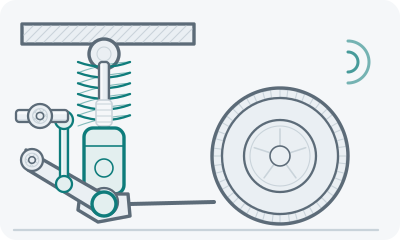
A dull knock from the front over potholes is the single most common suspension complaint there is. “Dull” is a useful clue in itself: the sound is softened by rubber, so the impact is passing through a rubber-and-metal joint or a damper rather than metal against metal. That narrows the list of suspects immediately. Here it is, from the most likely causes to the rare ones, with an assessment of how dangerous each is.
What the character of the sound tells you
Before listing parts, it is worth pinning down three things — they split the causes into groups better than any instrument:
- a single impact or a series. One thud in a large pothole is usually a damper or a control arm bush; a rapid series on washboard tarmac is anti-roll bar links;
- whether it depends on steering. If the knock changes in a corner, suspicion moves to the ball joint and the track rod ends;
- where you hear it. From the wheel — the arm and its joints; from “above”, closer to the bonnet — the strut top mount; from the centre underneath — the anti-roll bar or the undertray.
A mechanic will ask exactly these questions, so it pays to drive down a familiar broken street and note the answers in advance.
The main causes
| Part | Signature of the sound | What comes with it |
|---|---|---|
| Control arm bushes | dull knock over potholes | the car wanders, uneven tyre wear |
| Damper | single impact in a large pothole | body wallowing, bottoming out |
| Anti-roll bar links | frequent dull knock on washboard | knocking over speed humps |
| Ball joint | dull knock, changes in corners | sometimes a creak when steering |
| Strut top mount | knock from “above” | audible when steering while parked |
| Broken bump stop | hard impact in deep potholes | only at speed |
A control arm bush is a rubber sleeve pressed into a metal shell: it connects the arm to the subframe and absorbs vibration. When the rubber tears, the arm starts moving with an impact — that is the dull knock. A ball joint is the pivot the wheel steers on; its knock is the most worrying item on the list, because the end state of a worn ball joint is a wheel folded into the arch.
Checking it yourself
A proper check for play needs a lift, but a preliminary diagnosis can be made on the drive: rock the car by a wing, rock the wheel by hand in two planes, and inspect the joint rubbers for tears.
It is worth checking the link to temperature separately: if the knock is noticeably louder in the first minutes of a drive in cold weather and fades once things warm up, that is the signature of hardened rubber. And if the impacts come not over bumps but at the moment of pulling away and stopping, the picture is different — see the symptom page knocking in the suspension.
What is dangerous and what can wait
Anti-roll bar links and bushes are a comfort question: you can drive, and the repair can be planned calmly. Control arm bushes do not tolerate much: a broken joint speeds up tyre wear and wear on neighbouring parts, and the car holds a straight line less well. But a knocking ball joint or track rod end cannot be postponed: play in those parts grows unpredictably, and a ball joint letting go at speed means losing control. If the knock over potholes is joined by a change in the sound during corners or by play in the steering, go to a workshop within days, gently and without speed.
How the repair is decided
One rule saves the most money: do not replace parts on suspicion. Paying for a diagnosis is cheaper than working through half the suspension in search of one knock.
Two things are worth agreeing before the work. Dampers and springs are replaced in pairs across an axle, because a new damper on one side and a tired one on the other makes the car behave differently left and right. And wheel alignment after replacing arms, bushes or ball joints is not optional — those parts set the geometry, and skipping it shows up as tyres worn out within a few thousand kilometres.
Not sure which scenario is yours? Record the knock on a rough stretch in the Pro-Stuk app: it matches the sound against your answers to a few clarifying questions and shows the likely causes with an urgency level — which makes it easier to decide between going tomorrow and planning the visit calmly.
