

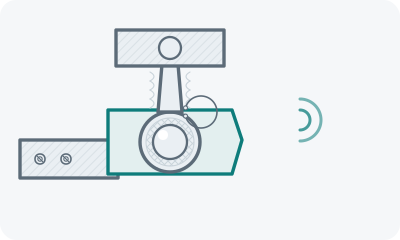
The ball joint and the bushes are neighbours on a suspension arm: the ball joint connects the arm to the steering knuckle, the bushes (rubber-metal joints) attach it to the body. As they wear, both knock on exactly the same small bumps, and even experienced drivers confuse them by ear. The cost of getting it wrong differs, though: a dead bush means discomfort and chewed tyres, a broken ball joint means a folded wheel. Here is how to separate these twins by the character of the sound, by simple tests and by a check on a lift.
Why they get confused
Both joints are loaded the same way: any bump sends an impact into the arm, and the arm sends it into both of its mountings. So they knock in the same situations — expansion joints, washboard surfaces, speed humps, pulling away and braking. The sound arrives from the same area: below, around the front wheel. The general description of the symptom is on the pages knocking in the suspension and knocking over bumps.
The difference lies in the material doing the knocking. In a ball joint the play is metal on metal, so the sound is bright and clipped. In a bush the impact is softened by rubber that is broken but still present — the sound is dull and “thick”. That is the main marker by ear.
A comparison by signs
| Sign | Ball joint | Bush |
|---|---|---|
| Character of the knock | Bright, metallic, clipped | Dull, rubbery, soft |
| Creak as the wheel is turned | Often, especially while parked | Rarely |
| Creak over bumps and when rocked | Possible | Characteristic, especially in frost |
| Pulling under braking | Slight | Noticeable: the car pulls to one side |
| Wheel alignment | Drifts at a late stage | Wanders, will not hold after adjustment |
| Tyre wear | Inner edge | Inner or outer edge, in patches |
| Risk if ignored | Pin pulled out, wheel folds under | Accelerated suspension and tyre wear |
No single sign gives the answer on its own — you look at the combination. A creak when steering on the spot plus a bright knock argues for the ball joint; a dull knock plus pulling under braking and an alignment that will not hold argues for the bushes.
Tests without a lift
- Rock the car by the wing. Bounce the car over the suspect wheel. A bright knock with a creak suggests the ball joint; dull creaks suggest the rubber.
- Brake over a bump. Drive over small bumps with light braking. With the suspension loaded by the brakes, a bush knock often quietens or changes character, while a ball joint knock usually stays.
- Steer while parked. Turn the wheel with the car standing and the window open. A creak or crunch from below argues for the ball joint — it is important not to confuse it with a sound from above, which is how a strut top mount bearing shows itself, described in strut top mount bearing noise symptoms.
- Look with a torch. Turn the wheel to full lock: a split ball joint boot with grease weeping out is almost a diagnosis in itself; cracks and tears in the bush rubber are visible at the arm’s joints.
Detailed checks of each part on its own are in signs of a worn ball joint and signs of worn suspension bushes, and the front arms specifically in front control arm bush wear symptoms.
How the diagnosis is made at a workshop
On a lift or over a pit the question is settled in ten minutes. The ball joint is checked by rocking the raised wheel top and bottom: play with a dull knock that does not disappear with the brake applied points at the joint. The bushes are checked with a pry bar: the arm is levered near each joint and watched for free movement — the arm should resist springily, not flop about. At the same time the mechanic inspects the boots and looks for signs of the bushes having shifted. The step-by-step method for the ball joint, with the differences between suspension types, is in how to check a ball joint yourself.
Worth remembering: both parts are often worn at the same time, since they age in the same conditions. If the whole arm is replaced, the question answers itself — a new arm comes with both the ball joint and the bushes.
Common self-diagnosis mistakes
A few traps people fall into when hunting a knock from below:
- Blaming “the rubber bits” because it is cheaper. A psychologically comfortable diagnosis, and exactly how people drive on a broken ball joint until the wheel folds under. When in any doubt, rule out the ball joint first — that is a safety question, not a comfort one, and what a failure looks like is in what happens when a ball joint breaks.
- Hunting the source by loudness. The body works as a resonator: a knock from the rear arm mounting can ring out at the sill, and it seems the middle of the car is knocking. It is safer to go by the conditions in which the sound appears than by the apparent location.
- Forgetting the anti-roll bar links. The third frequent source of knocks on small bumps — bright and rapid, similar to a ball joint. A diagnosis checks them first, because they are the cheapest of the three causes: checking anti-roll bar links for knocking.
- Checking by eye without load. Cracks in a bush and play in a ball joint only show themselves under force — with a bar or by rocking the wheel. A joint that looks intact from outside can be completely destroyed within.
How the repair is decided
The difference in cost between the two jobs is not dramatic, so there is no point economising on the accuracy of the diagnosis — what matters is not missing the ball joint. Beyond that, two questions decide the work. Whether the joints are serviceable at all: on many modern cars the ball joint and bushes are not sold separately, and the arm is replaced complete — which is often cheaper in labour than pressing joints in and out. And whether the arm is worth pressing new bushes into if it has already been apart once: a corroded seat will not hold a new bush for long.
One thing mechanics do not always say: after any work on the arms the car needs an alignment, and it should be done once the suspension has settled, not on the same lift with the wheels hanging. And new rubber bushes should be finally torqued with the car’s weight on the wheels — tighten them with the suspension hanging and the rubber lives twisted, then tears within months.
If the knock is already there and you are not sure, record the sound in the Pro-Stuk app. It will match the recording with your answers about when it knocks — over bumps, under braking or in bends — and show the likely causes with a level of urgency. With that you can go to a workshop and have specific parts checked instead of searching blindly.
