

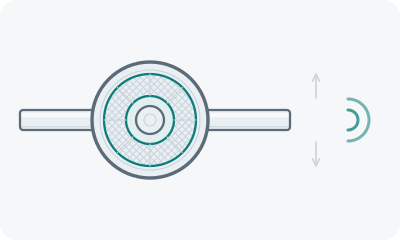
A control arm bush is a part people think of last: a rubber-to-metal joint through which a suspension arm attaches to the subframe. The rubber inside works both as a springy element and as a damper for small vibrations, so its wear shows up not as one loud symptom but as a cluster of small inconveniences that are easy to get used to. Here is that cluster, item by item.
What the wear sounds and feels like
The first thing people notice is a dull low thump over larger bumps: not a ringing rattle but a blunt knock, as though something in the suspension drops through. Over fine washboard a worn bush is usually silent, but coming off a kerb, over tram rails and in potholes it makes itself known.
The second is how the car behaves. Worn rubber lets the arm wander, and the wheel stops holding its set angle. The car follows ruts, the steering asks for corrections in a straight line, and under hard braking it pulls slightly. People describe the feeling as looseness: the responses have become slow and imprecise.
A separate marker is when the knock appears. A worn bush is especially willing to show itself when pulling away and braking, when the arm takes a longitudinal load: a dull thump at the front, as though something shifted and settled back. At a steady speed on a smooth road the same suspension is quiet.
The third is tyre wear. Because the geometry floats, the tread wears unevenly, often on the inner edge. If between two tyre shop visits you have been told “the tyres are eaten on the inside”, that is a serious reason to inspect the arms.
What is checked during a diagnosis
| Sign | What is checked |
|---|---|
| Cracks and tears in the rubber | Visually on a lift, with a light |
| The metal sleeve displaced | The sleeve has moved relative to the housing |
| Play under a pry bar | The arm moves relative to the subframe |
| Oil traces on the rubber | A leaking damper or steering rack accelerates the decay |
| Alignment that will not hold | The angles drift again after being set |
A detail that matters: bushes are best checked under load, so a good mechanic levers the arm with a pry bar rather than settling for a look. If the rubber looks intact but there is play, the inner layer is to blame and it is not visible from outside. The general breakdown is in signs of worn suspension bushes.
What it is often confused with
Neighbouring parts give similar symptoms. Body float after a bump and a longer stopping distance are more likely the dampers; their signs are in how to tell shock absorbers are dead. Crunching and clicking when steering while parked more often belong to the strut top mount, covered in a noisy strut top mount bearing. And a metallic knock with play at the wheel points at a worn ball joint. Compare your sound with the typical ones on the symptom page knocking over bumps.
The reverse is also true: bushes rarely die alone. If they have covered 120,000 km on broken roads, the ball joints and the anti-roll bar links are probably tired too. So it makes sense to diagnose the whole front suspension at once rather than part by part — that is cheaper than three separate visits.
How the repair is decided
Three things settle it before you compare prices.
Whether the bush is separately replaceable on your car or the complete arm is the only option — the two answers are not comparable in cost, and only the workshop manual for your model knows which applies.
Whether the bolts will be tightened with the car on its wheels at normal ride height. Tightened with the suspension hanging, the fresh rubber works permanently twisted and fails within 10,000–20,000 km — the single most common reason new bushes knock again.
And the alignment, which is a compulsory line rather than an option.
You can drive with worn bushes for a long time, which is exactly why they get neglected. The price is paid not in a breakdown but in indirect costs: a prematurely eaten set of tyres, faster wear in the ball joints and track rod ends, and imprecise behaviour at speed.
If thumps in potholes are already audible but you cannot tell where from, record a run over a familiar broken stretch in the Pro-Stuk app. It matches the character of the impact with your answers about speed and steering behaviour and shows the likely causes with percentages — leaving only the confirmation to be done on a lift.
