

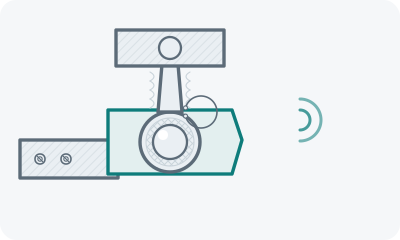
A ball joint is a small pivot that connects the suspension arm to the hub carrier. The weight of the car passes through it into the arm, and at the same time it lets the wheel steer. Of all the wear items in a suspension, this is one of the few whose failure turns not into an inconvenience but into an emergency. Here is what happens physically and which noises warn you in advance.
What happens at the moment it lets go
The stud pulls out of its housing, or out of its seat in the hub carrier. At that moment the wheel is no longer held from below by the arm and folds into the arch — the top leans out, the bottom tucks in. The car pulls sharply towards that wheel, the steering has no effect on it, and the body drops onto the arch liner, the brake disc or the arm itself.
At parking speed it usually ends with a bent wing and a tow truck. On a main road the consequences are heavier: the car darts sideways in a fraction of a second, you brake on three wheels, and a suspension component lying on the tarmac acts like an anchor. On top of that the brake hose almost always tears or the driveshaft is damaged — so the bill is never for one part.
The signals that arrive first
| What you notice | What it means |
|---|---|
| A torn boot on the joint | The grease has gone, water and grit are inside |
| A dull click over a kerb | A gap has opened between the stud and the housing |
| A creak when steering while parked | Dry friction in a joint with no grease |
| Play in the wheel, top to bottom | Wear has reached a mechanically obvious stage |
| Pulling to one side under braking | The wheel no longer holds its set angle |
A sudden failure with no warning does happen, but it is rare and usually follows a heavy impact — a deep pothole at speed, a kerb, a collision. In the overwhelming majority of cases the joint knocks over bumps for weeks first. The problem is not that the part hides its condition; it is the habit of blaming the knock on the state of the roads.
How to check it
The simplest check is to lift the wheel off the ground and rock it in the vertical plane, holding it at the top and the bottom. Play in that direction points to the ball joint or the wheel bearing; the character of the noise, and whether the wheel hums while driving, tells them apart.
The second check is visual: on a lift you look at the boot and at any grease thrown around it. The third uses a pry bar under load, and that is a mechanic’s job.
A sensible interval for an inspection is every 15,000–20,000 kilometres, or at every tyre change, when the wheels are off anyway. It costs nothing if you ask for it while the car is already up.
How urgent it is, and how the repair is decided
Noises in a car differ enormously in how long they can wait. A whining release bearing, for example, tolerates months. A ball joint is not on that list. With obvious play, the right tactic is not to drive long distances under your own power and not to leave it longer than a few days. To compare the character of the impact with other suspension noises, see the symptom page knocking over bumps.
Two things decide the shape of the repair. First, whether the joint is separate or built into the arm: on many modern cars it is not sold on its own, and the whole arm is replaced — a more expensive part, but a faster job. Second, what the failure has already touched: a joint that has been knocking for months puts extra load on the wheel bearing and the tie rod end, so a decent workshop checks both while it is in there rather than selling you a second visit later.
One step is not optional afterwards: wheel alignment. Replacing a ball joint changes the geometry, and skipping the alignment shows up as uneven, rapid tyre wear within a few thousand kilometres.
If a single dull click has appeared over bumps and you do not know how urgent it is, record a run over a familiar rough stretch in the Pro-Stuk app. It matches the character of the impact against your answers about speed and how the steering behaves, shows the likely causes with percentages and tells you whether driving there yourself is reasonable.
