

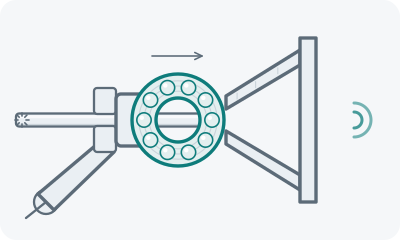
A noise that appears exactly as the clutch pedal goes down and stops when your foot comes off is almost the calling card of the release bearing. That is the part which passes the effort from the pedal to the pressure plate’s diaphragm spring while rotating with it. The sound frightens drivers more than it should: on its own it rarely means the car will stop tomorrow. But you cannot ignore it for years either — here is why.
How a worn release bearing sounds
The typical portrait is an even rustling hum that arises with the pedal down and disappears when it is released. The loudness does not depend on speed or gear: the sound is tied to engine revs, because the bearing turns with the pressure plate. At idle it is quieter, and with a throttle blip and the clutch held down it is noticeably louder — the full case is in whine with the clutch pressed.
As the wear progresses the hum coarsens: rumbling appears, a metallic note, sometimes a light vibration in the pedal under your sole. If the bearing has started to break up, the sound becomes intermittent — it disappears, then returns with a new note. That is a signal not to postpone the workshop visit.
A one-minute check
The diagnosis needs neither a lift nor tools. Start the engine, select neutral, let the car idle and listen. Then press the clutch pedal smoothly to the floor and hold it for a couple of seconds.
- The sound appeared on pressing — the release bearing is at work.
- The sound disappeared on pressing — the gearbox input shaft bearing was making it: with the pedal down it stops turning.
- The sound did not change — the source is outside the clutch: the accessories, the idlers, the alternator.
That simple test separates three stories of very different cost, so it is worth doing before the conversation with a mechanic. If the sound is more like a metallic knock or clatter when pulling away, see what a worn dual mass flywheel sounds like — different mechanics and a different budget.
What else makes noise in this area
| Source | When it is heard | Sign |
|---|---|---|
| Release bearing | Only with the pedal down | Even rustling hum |
| Input shaft bearing | At idle, pedal up | Quietens when pressed |
| Dual mass flywheel | At start-up and switch-off | Clatter, rattle, vibration |
| Engine mount | At idle and when pulling away | Jolts and knocks, not a hum |
| Accessory idler | Always, the pedal is irrelevant | Squeal or dry rustle |
Engine mounts are often confused with the clutch, because the vibration reaches the body in the same states — at idle and when pulling away. Their symptoms are covered in engine mount failure symptoms. The general catalogue of stray sounds at idle is on the symptom page vibration at idle, and the crackling version of the same area in crackling when pressing the clutch.
Can you drive, and how the repair is decided
You can drive — with two caveats. First: keep the pedal up wherever possible. The habit of sitting in traffic and at lights with the clutch held down wears the bearing faster than anything else. Second: do not wait until the clutch starts dragging — gears selecting with a crunch, the car snatching as you pull away. A disintegrating bearing can damage the pressure plate fingers, and then the whole kit is replaced.
The money follows from one fact: the bearing itself is a small share of the bill, and what you are paying for is removing the gearbox. Replacing it alone, leaving a worn disc in place, is almost a guarantee of repeating the whole operation in a year or eighteen months — signs of a worn clutch.
There is one more argument for not postponing. While the gearbox is off, the mechanic can see the state of the input shaft seal, the flywheel and the release fork — parts otherwise unreachable. If any of them is close to the end, it is wiser to close the question at once than to pay for a second removal a season later. So at the service desk it makes sense to ask outright for the whole assembly to be inspected and the removed parts to be shown to you.
Two things mechanics do not always say. If the car has a dual mass flywheel, its free play is measured with the gearbox off — that single figure can double the bill, and it should be a measurement rather than an opinion, signs of a failing dual mass flywheel. And a new clutch wants a gentle first few hundred kilometres to bed in, without towing or hard launches.
If you are unsure whether the sound really is tied to the pedal, record it in the Pro-Stuk app: two short clips, with the clutch pressed and released. The app compares the recordings and suggests which way to look before you arrive at the workshop.
