

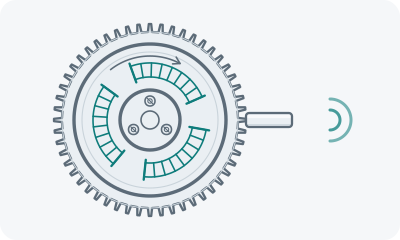
A dual-mass flywheel is a flywheel cut into two parts with springs and damping grease between them. Its job is to absorb the crankshaft’s pulses so that smooth torque reaches the gearbox. When the springs sag and the grease is used up, the two masses start knocking against each other, and the car acquires a set of characteristic sounds. Here is how they sound and what they are most often confused with.
The three moments when you hear it
A worn flywheel does not make noise constantly, only in specific regimes — and that is its main signature.
At startup. In the first second of cranking, a short metallic clatter or rattle comes from under the gearbox, as though loose iron were shifting in the housing. It lasts a fraction of a second and vanishes as soon as the engine catches.
At shutdown. The same clatter but noticeably louder: as the engine slows it passes through the resonant range. Many drivers notice this first — “the car clunks when I turn the key off”.
At idle and pulling away. A rattle appears that changes when you press the clutch, along with vibration through the floor and the gear lever. Shifting from first to second the car can shudder, especially when warm.
Telling it from the neighbours
| Part | When it makes noise | Character of the sound |
|---|---|---|
| Dual-mass flywheel | Startup, shutdown, pulling away | Clatter, rattle, vibration through the floor |
| Release bearing | Only with the pedal down | Even rustling whine |
| Engine mount | Pulling away, reverse, idle | Dull thump, a jolt into the body |
| Starter, ring gear | Only during cranking | Grinding, gear squeal |
| Undertray, exhaust | Over bumps, with vibration | Sheet rattle, ignores the pedal |
The key to separating them is the clutch pedal and the moment the sound appears. The flywheel responds to the engine starting and stopping; a mount responds to load changes when pulling away and shifting between drive and reverse. The general catalogue of rattling and shaking at idle is on the symptom page vibration at idle.
What a workshop checks
An exact diagnosis comes from the dismantled part: the flywheel is measured for free rotation angle between the masses and for run-out. While the gearbox is still in place, the mechanic builds an indirect picture:
- listens to startup and shutdown from outside, by the arch and from below;
- assesses vibration at idle with the pedal up and down;
- checks the engine mounts under load, so that someone else’s fault is not blamed on the flywheel — checking engine mounts under load;
- looks for traces of flywheel grease on the bellhousing, if any.
A separate point: cars with automatic gearboxes have no dual-mass flywheel in the usual sense — the torque converter takes that role, and noises from there sound quite different.
How the repair is decided
The economics are the same as with the clutch: you are mostly paying to remove the gearbox, not for the part. Hence a practical rule: if the clatter has appeared and the clutch has already covered more than a hundred thousand kilometres, it is more sensible to do everything in one visit — flywheel, clutch kit, release bearing and the rear main seal, because all of them are only reachable with the box out.
The second question worth asking is whether the flywheel can be resurfaced or must be replaced. Some can be machined once within a manufacturer’s limit; many cannot. A workshop that measures rather than guesses will tell you which.
Driving with a light clatter at shutdown is possible, but watch the trend: growing vibration and shuddering when pulling away mean the play has increased and delaying further stops paying.
Driving style extends the life of this part. A dual-mass flywheel copes worst with labouring at low revs — the car in a high gear near idle, with the engine tugging at the driveline. Early full-throttle upshifts in a heavy car, towing and stop-start city use all add wear. The habit of keeping the revs slightly higher and changing down before the engine starts to strain noticeably spares the damper.
If you want to know whether the sound really is tied to starting and stopping, record both moments in the Pro-Stuk app. It matches the character of the sound with the regime it appeared in and shows the likely causes with percentages.
