

A whine that switches on exactly when your foot presses the clutch and disappears the moment you let go is that rare case where the sound names the culprit itself. That is how a release bearing behaves: a part that spends most of its life doing nothing and works only while the pedal is down. Here is why, how to tell it from other transmission noises, and what the repair involves.
What happens inside when you press the pedal
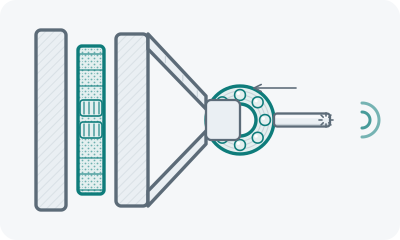
The clutch links the engine to the gearbox through a clamped disc. To break that link, the pressure plate’s diaphragm spring has to be pushed — and that is the release bearing’s job: it comes up against the rotating diaphragm fingers and presses on them. While the pedal is up, the bearing stands still and does not rotate. As soon as the pedal goes down, it is pressed against the spinning pressure plate and starts turning at engine speed.
Hence the character of the sound. Worn raceways only make themselves known under load and rotation, that is, strictly with the pedal down. An even, monotonous whine or rustle that grows with engine revs and vanishes instantly when you release the pedal is this part’s calling card.
Checking it in a minute
The check is done with the car stationary, in neutral, with the handbrake on:
- Start the engine and let it reach operating temperature.
- At idle, press the clutch smoothly to the floor and hold it for five to seven seconds. If a whine appears, the bearing is the suspect.
- Release the pedal. The sound should disappear as sharply as it came.
- Repeat at 1,500–2,000 rpm: release bearing whine changes pitch with the revs.
The mirror situation — a noise that instead disappears when you press the pedal — points not at the release bearing but at parts behind the clutch. If jerking when pulling away, a burnt smell and a loss of power on climbs join the whine, the whole clutch assembly deserves a look rather than one part.
What else whines at that moment
| Source | How to tell it apart |
|---|---|
| Release bearing | Whine only with the pedal down, grows with revs |
| Input shaft bearing | Whines in neutral with the pedal up, fades when pressed |
| Release bearing guide sleeve | Not a whine but a creak or click as the pedal moves |
| Fork and cable linkage | Dry creak in time with pedal travel, audible with the engine off |
| Alternator, water pump, idlers | The whine ignores the pedal entirely |
The key divider here is a single thing: whether the sound is linked to the pedal. If the whine lives its own life and does not react to the clutch, look among the accessories instead.
How the repair is decided
The deciding fact is that the gearbox has to come out, and that governs everything else. Two consequences follow. First, the clutch is replaced as a kit rather than one part: the disc, the pressure plate and the release bearing have the same age and the same wear, and doing them separately means paying the same labour twice.
Second, everything else that is only accessible with the box out belongs in the same conversation: the rear main seal, the guide sleeve, and the gearbox oil, which is drained anyway. A workshop that lists them is not padding the estimate.
There is one more question worth asking in advance: whether your car has a dual-mass flywheel and what condition it is in. It is inspected while the clutch is out, and if it is worn, replacing the clutch alone brings the vibration back within months. Finding that out after the gearbox is back in is the expensive way.
By urgency, a release bearing is not an emergency part. Months usually pass between the first whine and real trouble. But do not postpone indefinitely: the whine turns into grinding, the pedal travel changes, and a bearing that breaks up can damage the pressure plate fingers and turn an ordinary repair into an expensive one.
If the whine is quiet and you are not sure it is linked to the pedal, record the sound in the Pro-Stuk app — first at idle with the pedal up, then with it down. The app compares the recordings, matches them with a few answers and shows the likely causes with percentages.
