

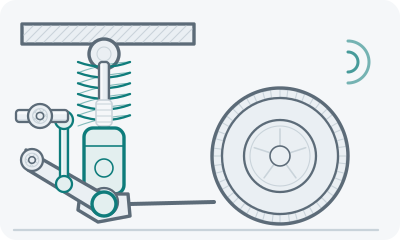
A creaking suspension is a sound drivers put up with for months: the car rides fine, nothing knocks, but on every bump something groans or sings. Most often that really is harmless — dry rubber creaking. But a creak has serious sources too, and it matters not to miss them. Below: where a creak comes from, how to find its source without a lift, when grease is enough and when replacement is needed.
Where a creak comes from
A creak is the sound of friction rather than impact, and that is what fundamentally separates it from a knock: a knock speaks of play, a creak of dry contact between two surfaces. In a suspension three pairs mainly rub:
- rubber on metal — anti-roll bar bushes on the bar, control arm bushes, damper bushes;
- metal on metal — ball joints and track rod ends left without grease after a boot tore, coils of a sagged spring on its seat;
- rubber on rubber — bump stops and damper boots, occasionally body seals that creak “like the suspension”.
The good news: a creak is almost always audible without driving — rocking the parked car is enough. That makes it far easier to locate than a knock, which often only reproduces at a certain speed on certain bumps. So a creak can usually be pinned down on your own driveway.
The main sources
| Source | How it sounds | When it appears | What to do |
|---|---|---|---|
| Anti-roll bar bushes | Groaning, creaking over gentle bumps | After rain, a wash, in frost | Grease or replace |
| Control arm bushes | Creak on suspension compression | More often in frost, on older cars | Replace when worn |
| Ball joint, track rod end | Dry creak when steering and over bumps | Constantly, progressing | Replace without delay |
| Strut top mounts | Creak when steering while parked | When steering and over bumps | Diagnosis, replacement |
| Spring on its seat | Creak-scrape when rocked | Under load | Inspect: is a coil broken? |
| Boots and bump stops | Rubber squeak on compression | On larger bumps | Grease or replace, cheaply |
The most common find is the anti-roll bar bushes: two rubber blocks in which the bar rotates on every roll and every bump. Grease leaves them, dust works as an abrasive — and the rubber starts to sing. Their neighbour by symptoms is the anti-roll bar links: worn joints usually knock, but at an early stage, while the joint is dry, they creak too. Their signs are in signs of worn anti-roll bar links and the bushes’ own in signs of worn anti-roll bar bushes.
Control arm bushes creak differently — duller, and usually on compression, when deformed or torn rubber slips against its sleeve. Cracks, tears and squeezed-out rubber are visible to the eye; the details are in signs of worn suspension bushes.
Creaking and the weather
A creak has a characteristic feature — it depends on the weather, and that tells you a lot before any inspection:
- after rain and washing — water has removed grease and dust from the rubber bushes; that creak usually clears as things dry;
- in frost — the rubber stiffens and slips with a creak; as the suspension warms over a few kilometres the sound fades;
- the creak disappears in hot weather — soft rubber slides more quietly; that is not a recovery, and it returns in autumn.
A creak that ignores the weather and sounds the same at any temperature is an argument for metallic friction: ball joints, track rod ends, a spring. That source matters more and should be found faster.
How to find the source
- Rock each corner. With the car parked, push firmly down on each corner. If the creak reproduces, the source is in that corner; a helper listens at the wheel and under the arch.
- Steering while parked. Turn the wheel lock to lock without moving: a creak from above under the wing suggests the strut top mounts, from below the ball joints or track rod ends.
- Test greasing. Silicone grease on the anti-roll bar bushes is a legitimate diagnostic trick: the creak goes, the source is found.
- Inspect the boots. A torn ball joint or track rod end boot combined with a creak is grounds for replacing the part without further experiments — see signs of a worn ball joint.
If a knock has appeared alongside the creak, start with the knock — play matters more than dry rubber: the search route is on the symptom pages knocking in the suspension and knocking over bumps.
Grease or replace
The general rule: rubber that creaks from dryness can be greased to buy time; rubber that creaks because it is breaking up, and metal creaking without grease, can only be replaced. Saving on cheap bushes is rarely justified — a second workshop visit costs more than the parts.
One thing worth asking when bushes are replaced: that the bracket bolts are torqued rather than guessed, and that new bushes match the bar diameter exactly. An oversized bush is the classic reason a creak survives the repair.
If the sound does not tell you whether this is a harmless creak or a worn joint, record it in the Pro-Stuk app: it matches the recording with your answers about when the sound appears and shows the likely causes with an urgency rating.
A short checklist before the workshop
Five observations are enough to arrive prepared: which side creaks (left or right, front or rear); whether the creak depends on the weather; whether it appears when you rock the parked car by a wing; whether it changes after the underside is washed; and whether it coincided with any recent suspension work. Those five answers narrow the list of suspects faster than half an hour on a lift, and a mechanic will thank you for the specifics.
