

Anti-roll bar bushes are rubber rings costing the price of a couple of coffees that can sound like a serious suspension failure. A dull knock on every bump, creaking when the car is rocked — from the description you could suspect anything, up to and including the dampers. Here is how the part works, how to identify the bushes specifically, how to check them without a workshop, and what the replacement involves.
What anti-roll bar bushes are
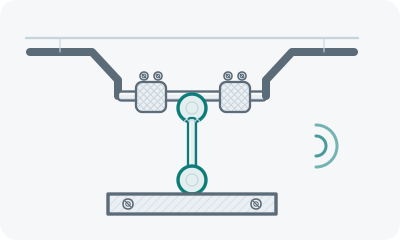
The anti-roll bar is a springy metal bar linking the left and right wheels of one axle. As the body rolls in a corner, the bar twists and resists the roll. It attaches to the subframe or body through bushes — rubber mounts inside which the bar rotates on every suspension movement.
The bushes’ rubber ages from loads, temperature swings and road salt: it hardens, loses its elasticity and wears through from inside. A gap appears between the bar and the bush — and the bar starts moving in it with impacts. That is the source of the sound.
What worn bushes sound like
The signature is recognisable:
- a soft dull knock over small bumps — ripples, joints, tram rails; on large potholes it is lost in the general work of the suspension;
- a knock over speed humps and entering car parks — wherever the body rolls;
- creaking when the car is rocked by hand, noticeably louder after rain, a wash or in frost;
- the location is at the front, low down, closer to the centre of the car rather than at a wheel;
- on smooth roads, silence — the sound is strictly tied to bumps, as on the symptom page knocking over bumps.
An important difference from the dangerous causes: a bush knock does not change in corners at speed and is never felt through the steering wheel.
Bushes or links: telling them apart
Anti-roll bar links — the short rods with joints connecting the bar to the suspension — wear from the same loads and sound similar. The differences:
| Sign | Bushes | Links |
|---|---|---|
| Character of the sound | Soft, dull, closer to the centre | Chattering, sharper, closer to the wheel |
| Creaking | Often, especially in damp | Rarely |
| Check by hand | The bar moves inside the bush when rocked | Play in the link when rocked by the rod |
| Part cost | Very low, sold in pairs | Low, per side |
In practice you do not have to separate them before the workshop visit: both are checked in five minutes on the same lift and are often replaced together, since they age as a pair. The links’ own signs are in signs of worn anti-roll bar links. If the sound fits neither portrait, widen the circle: bushes and dampers give similar thumps, and their signature is covered in a dull knock from the front over potholes.
How to check them yourself
Two tests work without a lift. The first is rocking: push rhythmically on the wing; a dull knock or creak from below, centrally, points at the anti-roll bar. The second needs a helper: they rock the car while you listen from under the arch to work out which side and what height the sound comes from.
On a lift it is simpler: the mechanic levers the bar with a pry bar and watches whether it moves inside the bushes. That check takes minutes and is often free when you book the repair.
How the replacement is decided
This is one of the cheapest suspension repairs, and no alignment is needed afterwards — anti-roll bar parts do not affect the wheel angles.
Three things are worth knowing before the job. New bushes must match the bar’s diameter exactly: a bush one size up is the classic reason the knock survives the repair. The bracket bolts should be torqued rather than guessed, because an over-tightened bracket squeezes the rubber out of shape and it fails within a season. And the bar itself deserves a look where the bushes sit — if it has been running loose long enough to wear a groove into the metal, new bushes on a grooved bar will not sit properly.
Leaving it is not worthwhile either: a loose bar wears not only the bushes but its own mounting points, and replacing the bar is a different order of cost.
Not sure it is the bushes knocking? Record the sound on a representative stretch in the Pro-Stuk app: the algorithm matches the recording with your answers and shows the likely causes with percentages and an urgency level — so you arrive at the workshop with a working theory rather than a guess.
