

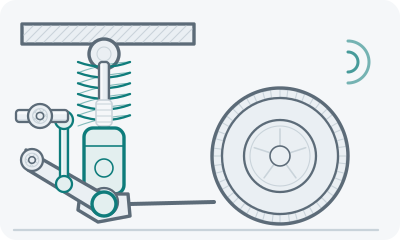
A speed hump is almost an ideal test rig for a suspension. The wheel rises smoothly through its full compression travel, then returns sharply, and the body leans and rocks. Parts that stay silent on small bumps give themselves away here. Here are the components that most often knock over artificial humps, how to narrow the field of suspects without a lift, and what decides the repair.
Why the knock appears on a wave
An artificial hump has a particular geometry: it is long and sloping, so the suspension gets not a sharp impact like a pothole but nearly its whole travel — first compression, then rebound (the return stroke as the wheel extends downwards). At the same time the body leans, bringing the anti-roll bar into play.
Hence three typical scenarios:
- a knock on rebound — a tired damper or its top mount fails to restrain the suspension extending, and the parts reach their end position with an impact;
- a knock on compression — crossing too fast, the suspension bottoms out on the bump stop, the rubber buffer on the damper rod;
- a knock from body lean — play in the anti-roll bar links or bushes, which are loaded most on a wave.
There is a fourth and most harmless version: the knock comes not from the suspension but from what is bolted to it or lying next to it — an undertray with loose fasteners, a jack in the spare wheel well, unsecured luggage in the boot. On a wave the body rocks with all its weight and any free object answers. So the first diagnostic step is to take the excess out of the boot and rock the undertray by hand with the car parked.
Which parts knock most often
| Part | Character of the sound | Additional signs |
|---|---|---|
| Anti-roll bar links | Dull chattering knock | Also heard on fine ripples |
| Anti-roll bar bushes | Soft knock, sometimes with a creak | Creak when the body is rocked by hand |
| Damper | A single impact on rebound | The car rocks after the wave |
| Strut top mount bearing | Knock “from above”, under the bonnet | Also heard when steering while parked |
| Destroyed bump stop | Hard impact on compression | Only at speed, felt through the body |
Statistically the anti-roll bar links and bushes lead: they are cheap, work in the most heavily loaded conditions and on broken roads rarely survive 60–80 thousand kilometres. If the knock is heard not only on waves but on any fine ripple, it is worth starting with front suspension knock over small bumps.
Narrowing the field without a lift
A few observations that genuinely help a mechanic reach a diagnosis faster:
- Speed of crossing. A knock only when crossing fast looks like the suspension bottoming out; a knock even at 10–15 km/h means play in the joints or the anti-roll bar.
- Bouncing on the spot. Press on the wing several times and release sharply. A knock or creak while bouncing points at the anti-roll bar or the top mount, and more than one free oscillation of the body points at a weak damper — checking shock absorbers with the bounce test.
- Loading. Put passengers in and cross the same wave. If the knock vanishes, the clearance is taken up by weight — anti-roll bar bushes or mounts are likely, and the case is covered in a knock only with passengers or a load.
- Steering. Turn the wheel with the car parked. A knock from under the bonnet in time with the movement is the handwriting of a top mount bearing — strut top mount bearing noise symptoms.
- Sides. Ask a passenger to open a window and listen for which side is louder: anti-roll bar parts almost always knock on one side, bottoming out at speed happens on both at once.
Single impacts over potholes have their own handwriting, covered in a dull knock from the front over potholes. The general map of causes is on the symptom page knocking over bumps.
How the repair is decided
Two findings decide the work. If the play is in the anti-roll bar links or bushes, that is the cheapest repair in the suspension: diagnosis and replacement usually fit into one visit, and nothing else has to come apart. If the damper is at fault, the job is larger by definition — dampers are replaced in pairs across an axle, and while the strut is apart the top mount, the bump stop and the boot are assessed and usually replaced with it.
Two things mechanics do not always say. Bump stops and boots are cheap but are only reachable with the strut stripped, so leaving them out to save money means paying the same labour again later. And the anti-roll bar fasteners are often seized: on a car that has seen salt, allow for the possibility that a link comes out with its bracket, which changes the quote after the wheel is off rather than before.
Access is the other variable: on crossovers and cars with multi-link rear suspension the same operation costs more simply because the fasteners are harder to reach.
Is it dangerous to postpone
Anti-roll bar links and bushes create no direct danger: the car stays controllable, and what suffers is comfort and steering precision in bends. But any knock is metal hitting metal, which gradually hammers out the seats — and a few months later, instead of bushes, you can be replacing the anti-roll bar itself.
Dampers are more serious: a worn damper lengthens the stopping distance and increases body movement, and every bottoming out passes an impact into the body, the wheel bearings and the arm bushes. That cascading character of wear is the main argument against waiting: a part that costs little today drags its neighbours with it in six months — what driving with dead shock absorbers leads to.
So the rule is simple: knocking in the suspension over waves is a reason to book a diagnosis within the next week or two. If the sound comes with the car pulling to one side or play in the steering, sooner.
To avoid guessing from descriptions, record the sound on your phone as you cross the obstacle: the Pro-Stuk app matches the recording with your answers and shows the likely causes with percentages and a level of urgency — with that list the conversation at the workshop turns specific.
