

A pad change is one of the most straightforward jobs in servicing a car, which makes driving out of a workshop with a new noise all the more annoying. A squeak at a traffic light, a rustle while coasting, a slightly longer stopping distance on the first day — all of it often worries people more than the worn-out pads that were carrying the car until yesterday. Most of those sounds belong to bedding in and clear by themselves. The rest say something was missed during fitting, and it is useful to be able to tell them apart.
What happens to new pads over the first few hundred kilometres
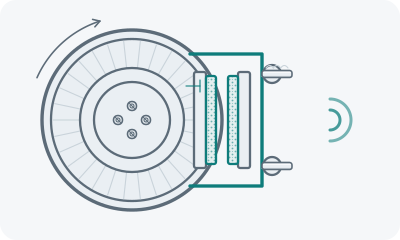
A brake pad does not work metal on metal but through a thin transfer layer: particles of friction material move onto the disc and form an even film on it. Until that layer has formed, the contact is uneven — hence the vibration, the noises and the slightly changed pedal feel.
The second factor is geometry. A new pad is flat, while a disc that has covered 30–40 thousand kilometres has a surface profile of its own. Over the first few hundred kilometres the pad takes the shape of the disc, the contact area grows and the noise gradually goes. The normal period is 200–500 km of ordinary town driving, without hard stops from high speed in the first days.
Normal and not normal: a short summary
| Noise after the change | Assessment |
|---|---|
| Occasional squeak at lights for the first 2–3 weeks | Normal, bedding in |
| A light rustle while coasting | Normal, the pad touching as designed |
| Squeal under light pressure, gone under hard braking | Usually normal; slide pin grease helps |
| Constant squeal after 500–700 km | Not normal: shims, grease, pad compound |
| Metallic grinding from day one | Not normal, check the fitting immediately |
| A knock at the first press and on release | Not normal: the pad is moving in its guides |
Hard pad compounds with a high metal content deserve a separate mention. They are durable and handle heat well, but they are noisier by nature than soft ones. Such a set can squeak for its whole life while remaining completely healthy — a question of part choice at the next change rather than of repair. How wear sounds at each stage is in telling brake pad wear by ear, and the low-speed squeal case in brake squeal at low speed.
What is most often missed during fitting
The list is short, and every item is worth checking if the noise has not gone within a month:
- Grease on the caliper slide pins. Without it the pad sits at an angle, wears tapered, and the mechanism squeals and binds — signs of seized caliper slide pins.
- Anti-rattle shims. Thin metal plates that damp the pad’s vibration. They are sometimes not transferred from the old set, or fitted askew.
- Cleaning the seats. Rust and baked-on dust in the caliper carrier stop the pad moving freely.
- The state of the disc. A deep lip at the edge stops the new pad seating properly — the same fork is covered in brake squeal: pads or discs.
- Torque and carrier seating. An under- or over-tightened slide pin bolt changes the geometry of the clamping.
A morning squeak that appears after a night outside and disappears within a couple of stops has nothing to do with the fitting — that is surface film on the disc, covered separately in brake squeal after standing and brake squeal after rain. The general catalogue of brake sounds is on the symptom page squealing brakes.
How the decision is made
The sensible sequence: give the set 300–500 km of calm driving, then judge the sound again. If it has changed for the better, wait for bedding in to finish. If it is the same or worse, go back to the workshop that fitted the pads: stripping and reassembling the mechanism under the labour warranty is usually free — which is exactly why the trend test comes before any spending.
Two things mechanics do not always say. The fitting kit — shims and springs — is a consumable and is what stops a pad vibrating; if it was not included, that alone explains a squeal that never fades. And bedding in is a procedure, not just waiting: several dozen moderate stops from 60–80 km/h, without hard braking and without holding the car on the pedal at a standstill while the brakes are hot, is what forms an even transfer layer.
There is one sound that does not tolerate a wait-and-see pause: hard metallic grinding from the first kilometres. It means the pad is fitted wrongly or something foreign has got into the mechanism, and in that case you return to the workshop straight away rather than driving it in — can you drive with grinding brakes.
To avoid guessing whether the noise is within normal, record it in the Pro-Stuk app on the first day after the change and again two weeks later. Comparing the two recordings shows the trend more clearly than any impression: bedding-in noise weakens noticeably in that time, while a fault stays where it is or grows.
