

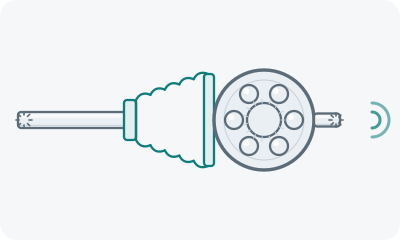
Clicking and crunching from a front wheel is a sound that almost always comes down to two components. The first is the outer CV joint: it transmits drive to the wheel while letting it steer. The second is the brake mechanism, where the pad, the caliper carrier and the disc form a moving assembly with clearances. Both live in the same place, so the source cannot be identified by tone alone. What separates them is not the timbre but the circumstances: what angle the steering is at, whether drive is applied, and whether the brake pedal is pressed.
The CV joint: crunching at an angle, under power
The classic picture of a worn outer joint is a series of dry clicks or a chattering crunch that appears when three conditions coincide: the wheel is turned to a large angle, the car is moving, and drive is applied to that wheel. Driving a slow circle on a car park under light throttle, the crunch is clear and synchronous with wheel rotation. Straighten the steering or lift off and the sound disappears.
In the vast majority of cases the root cause is one thing: a torn boot. Grease escapes through the split and sand and water get in, the joint’s tracks wear and the clearances grow. That is why inspecting the boot comes first in the order of checks. The stages of that wear are set out in signs of a worn outer CV joint, and the confirmation test in checking a CV joint by driving circles.
The brakes: clicks without the steering
Brake clicks live by different rules. They appear when the direction of force changes: pulling away after braking, at the first press of the pedal, when releasing the brake. The steering does not affect them. The causes are standard — a pad moving in the carrier because the springs and shims are missing, a lip on the disc, a slide pin that has seized and moves in jerks, or simply a loose carrier bolt.
| Condition | CV joint | Brake mechanism |
|---|---|---|
| Tight turn under power | Crunch, series of clicks | Silence |
| Straight road, steady speed | Silence | Possible clicks over bumps |
| First press of the pedal | No reaction | A single click |
| Pulling away | Possible click with heavy wear | A common picture |
| Reverse at full lock | The crunch is louder | Unchanged |
| Inspection | Torn boot, grease on the wheel | Pad play in the carrier, a lip on the disc |
A useful extra test: drive a slow circle in reverse with the steering at full lock. A worn outer CV joint shows itself loudest in that regime. The general catalogue of clicks in a turn is on the symptom page clicking when steering, and the single-clunk case in a single clunk when pulling away and braking.
What is looked at during an inspection
The wheel is raised, both driveshaft boots are inspected for cracks and thrown grease, and the joint is checked for axial and angular play. Then the wheel comes off and the brake mechanism is assessed: the slide pins’ freedom, the presence of anti-rattle shims, the state of the pads and the disc’s edge. Seized pins have their own breakdown in signs of seized caliper slide pins.
How the repair is decided
The difference between rebuilding a joint with a new boot and replacing it is the best argument for inspecting the boots at least once a season: before the tracks are worn, a boot and fresh grease save the joint; afterwards they do not.
One more budget nuance: a complete driveshaft is sometimes cheaper than a separate joint plus the labour to fit it, especially on common models. Ask about that option before the part is ordered — the figure and the timescale can differ noticeably.
On the brake side, the question worth asking is whether the fitting kit is included with the pads: the shims and springs that stop a pad rattling are consumables, and pads fitted without them start clicking again within weeks.
If the clicks are occasional and cannot be reproduced on the ramp, record the sound in the Pro-Stuk app during a slow circle under light throttle, and separately at the first press of the pedal. From those two recordings the app shows the likely causes with percentages and suggests which component to look at first.
